
Group J Preview
"Group of Deserts and Alps"

OVERVIEW
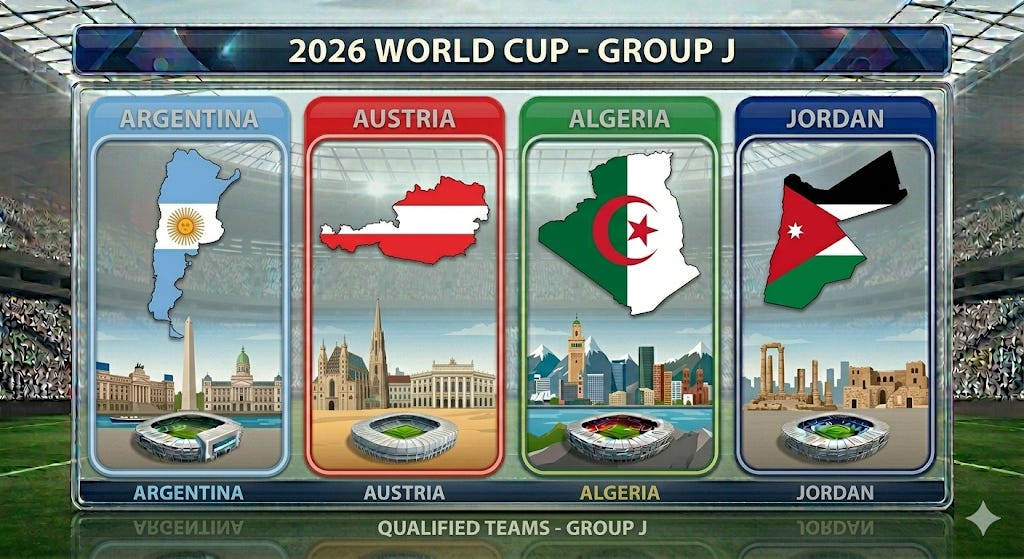
Defending champions Argentina look to be the first team since Brazil in 1958 and 1962 to win back-to-back world cups. Austria makes their first appearance at a world cup in this millennium, with a high energy team that could do some damage this summer. Algeria also returns to the world cup after missing the last two tournaments with a squad that is not short of attacking talent. Finally, Jordan will be making their world cup debut with the hope they can pull off a shock or two as underdogs of the group.
Skip to: Argentina, Austria, Algeria, Jordan
THE NATIONS
ARGENTINA
Nicknames: La Albiceleste (The White and Sky Blue), La Selección (The Selection),
World Cup Appearances: 19 (1930, 1934, 1958, 1962, 1966, 1974, 1978, 1982, 1986, 1990, 1994, 1998, 2002, 2006, 2010, 2014, 2018, 2022, 2026)
Best Finish: Champions (1978, 1986, 2022)
QUALIFICATION
Defending champions Argentina come into the 2026 FIFA World Cup looking to be the first team to win back-to-back world cups since Brazil in 1958-1962. This version of Argentina is a team at a crossroads, as a generation of veteran world class stars, making their final world cup appearance, will be blended with a young crop of exciting talents. The Argentinians kicked off their defense of their world cup title in September 2023, with a 1-0 win over Ecuador in Buenos Aires, laying the foundation for a strong CONMEBOL world qualifying campaign. In the following 17 matches, La Albiceleste cruised through group play, finishing first with 38 points (12 wins, 2 draws and 4 loses) and a resounding +21 goal difference (31 goals scored and 10 goals conceded). They secured qualification for the world cup with five matches to spare (finished nine points ahead of second place Ecuador), with a 4-1 win over arch rivals Brazil on Matchday 14 the central highlight of the campaign. They enter the 2026 FIFA World Cup as one of the top contenders to protect their crown.
THE MANAGER
Lionel Scaloni
Before Lionel Scaloni took over as manager of La Albiceleste, Argentina were in the midst of a 28-year title drought and the pressure was negatively impacting the players and their confidence. Since his appointment as senior national manager in 2018, Scaloni has transformed Argentina back into a dominant global force, leading his homeland to victory at the 2021 and 2023 Copa Américas, the 2022 FIFA World Cup and the 2022 Finalissima. He rejuvenated the squad with young talent, fostered a united team culture, and provided tactical flexibility that liberated their legendary star Lionel Messi. In the process, he has established himself as one of the best international managers in the game today, winning the IFFHS World’s Best National Coach (2022, 2023), The Best FIFA Men’s Coach (2022), South American Coach of the Year (2022) and the Glove Soccer Career Coach (2023) awards. As he looks to win his fifth title as manager, Scaloni has kept the same tactical plan in place from years ago, utilizing a 4-3-3 system that principles focus on: collective pressing, rapid transitions and flexibility between controlling tempo/possession and hitting teams on the counter. The attacking shape allows for individual brilliance to shine while out of possession the Argentinians maintain a disciplined but aggressive compact mid-block. Scalopini will field the oldest team at the world cup (29.3 average age) but that just means they are even more experienced in his title winning tactical system, which is a scary thought.
THE STAR MAN
Lionel Messi
(Attacking Midfielder, Right Winger, Striker)
Inter Miami’s Lionel Messi will go down as the greatest player to have ever (“GOAT”) played the game, when it’s all said and done. There is nothing, in both club and international football, that he has not achieved. Messi has won a record eight Ballon d’Ors, six European Golden Shoes, and eight FIFA Player of the Year awards. On top of that, he has won a record 46 collective trophies including 10 La Liga Titles, two Ligue 1 titles, four UEFA Champions Leagues titles, three UEFA Super Cups, three FIFA Club World Cups, an MLS Cup, an Olympic Gold Medal, two Copa Américas and the one FIFA World Cup. The awards, record and accolades go on and on for Messi and, for Argentina, he is their all-time leading goalscorer (116 goals) and most-capped player (198 appearances). Now 38-years old, this will be Messi’s final world cup (this summer’s tournament will be his sixth world cup) and while he isn’t at the height of his powers anymore, he is still an elite player that will dictate the Argentinian game at the 2026 FIFA World Cup. Known for his low center of gravity, which gives him greater agility and the change direction on a dime, Messi sees the game differently than most players (he is constantly scanning the field to anticipate teammate positioning and defender body language) and can pick out passes or score goals that seem impossible to attempt. His vision is exceptional and his dribbling and close ball control is mesmerizing, despite not being flashy. Messi creates and finishes at a world class rate, making him the ultimate offensive weapon. For Argentina, he will drift from the right wing spot to central positions to control the tempo of the attack and use his signature “start-stop” dribbling skills to freeze defenses before threading precise through balls or unleashing his deadly curling finesse shots. He will expect many fouls coming his way, as that is often the only tactic opposing teams can use to slow him down once he is in his groove but, even then, that seems to re-energize him and make him even more cerebral. While he has nothing left to prove in the game, the prospect of winning back-to-back titles and going out as a world champion at your last world cup is all the motivation Messi needs to put on a “swan song” performance for the ages at this summer’s world cup.
THE SQUAD
Goalkeeper
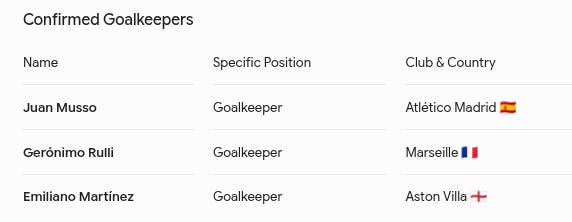
Controversial, yet elite, goalkeeper Emiliano Martínez of Aston Villa will continue as first choice in net for La Albiceleste this summer. Known for being a specialist when it comes to saving penalties, he has racked up the accolades as Argentina’s starting keeper, winning the Golden Glove at the 2021 and 2023 Copa Américas, the Best Goalkeeper award at the 2022 FIFA World Cup, the 2022 and 2024 Best FIFA Goalkeeper and the 2023 and 2024 Yashin Trophy. Martínez has firmly established himself as one of the best goalkeepers in the world and couples high quality shot-stopping and distribution ability with a bravado and moxie, that make him a larger-than-life personality between the posts. Marseille’s Gerónimo Rulli and Atlético Madrid’s Juan Mosso will be the depth goalies behind him.
Defense
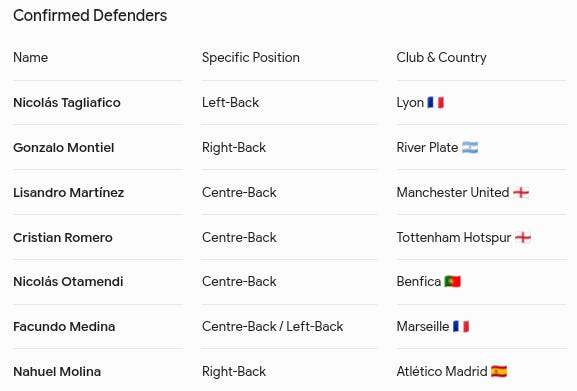
Scaloni’s defensive tactics emphasize control, compactness and high-intensity pressing in order to control the tempo of the game and mitigate the threats of quick transitions against them. The back four likes to play a high defensive line and uses rapid pressing to disrupt the opponents offensive build-up. They make sure to maintain tight spacing between them and the midfielders to restrict space for opponents.The full backs are crucial to Scaloni’s system and, in attack, they operate high up the pitch, often acting as wingers to stretch the pitch. From the right back position, Atlético Madrid’s Nahuel Molina bombs forward to support the attack while, on the left, Olympique Lyonnais’ Nicolás Tagliafico (or RC Strasbourg’s Valentín Barco) provides balance and defensive solidity. Out of possession, the duo work hard to recover quickly and collectively press to stifle quick counters. At the heart of the defense, the Argentinians will likely be without one of their defensive leaders in Cristian Romero of Tottenham Hotspur. While there is a small chance he recovers from his knee ligament injury in time for the tournament, it seems more likely that the Argentinians will rely on the center back pairing of Manchester United’s Lisandro Martinez and Benfica’s Nicolás Otamendi. The latter is a very experienced player, having made 130 appearances for his homeland. The center backs are aggressive in their challenges and play an important role in build-up play, using short, angled passing to control tempo and transition to attack. They are tasked with breaking high presses and utilize rapid recovery speed when playing the high line.
Midfield
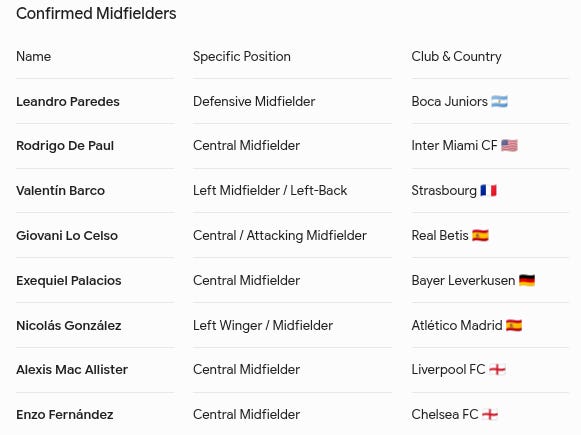
The Argentinians line up in a narrow, experienced three-man midfield. The trio operates with a mix of possession and opportunistic, quick-strike passing to the attackers. The engine of the midfield is Inter Miami’s Rodrigo De Paul, who leads the midfield press and covers a bunch of ground, breaking up play. He serves as the main protector in midfield and his presence allows the creative players, particularly Messi, to have freedom to orchestrate the attack. He is seen as the man that knits the Argentine structure together with his intense work rate and covering in midfield. Operating in an advanced midfield double-pivot will be Chelsea’s Enzo Fernández and Liverpool’s Alexis Mac Allister. Four years ago, Fernández won the Best Young Player Award at the Qatar world cup and offers both defensive solidity and passing range to break defensive lines. He will be a more box-to-box midfielder but contributes heavily to the playmaking side of the game. Mac Allister can also play a two-way game but for Argentina will be asked to dictate high midfield tempo, moving the ball efficiently and offering composure under pressure in order to release the front three. Above all else, the midfield’s primary mandate is to provide a solid base that allows Messi to act as a playmaker in his advanced creative role and to support the high-intensity attack. The midfield depth is solid with the likes of Como’s Nico Paz, Bayer Leverkusen’s Exequiel Palacios and Boca Juniors’ Leoandro Paredes all capable of making an impact off the bench.
Attack
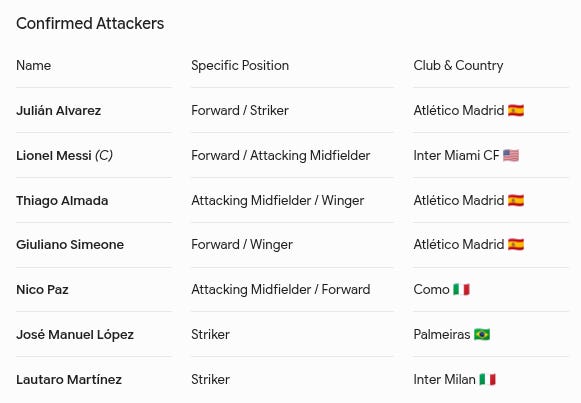
The Argentine attack runs through star man Messi, who will start on the right wing but drift in centrally throughout the game to serve as the primary creator in the center of the pitch. By doing so, he allows Molina to push forward to provide width to the attack on the right wing. On the opposite flank, Atlético Madrid’s Julián Alvarez, who is usually a striker, will play left wing in Scaloni’s system and, in addition to the goal threat he provides, he is also relentless in his pressing and uses his intelligent movement to open up space for his teammates. The primary striker is Inter Milan’s Lautaro Martínez and he makes smart runs, links up play and provides clinical finishing as the team’s main goal threat. In attack, the formation can shift to a 4-4-2, with Messi and Mac Allister playing the central attacking midfielder roles and Alvarez and Martínez playing next to each other in a two-striker system. Atlético Madrid’s Thiago Almada, Real Madrid’s Franco Mastantuono and Chelsea’s Alejandro Garnacho are the super subs off the bench for La Albiceleste’s attack.
OUTLOOK
Defending their world cup title will be a tough task but Argentina have the experience, star power, structure and unified team spirit to do so. They might be an older team but they have some exciting young options that can freshen the squad throughout the tournament and give them a jolt of energy should they become stagnant. La Albiceleste should top Group J and win at least their first two knockout round games. Anything less would be considered a major disappointment. Beyond that, they are capable of reaching the final but that seems more of a possibility rather than a foregone conclusion with this older iteration of Argentina.
Predicted Group Stage Finish: 1st
AUSTRIA
Nicknames: Das Team (The Team), Burschen (The Boys), Unsere Burschen (Our Boys)
World Cup Appearances: 8 (1934, 1954, 1958, 1978, 1982, 1990, 1998, 2026)
Best Finish: Third place (1954)
QUALIFICATION
In one of the more surprising facts surrounding this tournament, the last time Austria qualified for a world cup was before the turn of the current millennium, with their last appearance coming in 1998. However there were signs that Austria were on the right path towards qualification to this summer’s tournament, having qualified for Euro 2016, Euro 2020 and Euro 2024, with the national team getting out of the group stages in the latter two tournaments. Fueled by this continental resurgence, the next step was for the current generation to put an end to their world cup drought when they kicked off UEFA world qualifying in Group H. Group H consisted of Bosnia and Herzegovina, Romania, Cyprus and San Marino, with the Austrians getting off to a fast start, winning their first four games, including a historic 10-0 win over San Marino. Ultimately, the Austrians finished top of the group with 19 points, with a 1-1 draw against Bosnia and Herzegovina in Vienna in November 2025 being enough to secure the point they needed to finish first and qualify directly for their first world cup in 28 years.
THE MANAGER
Ralf Rangnick
Known as the “godfather” of modern German football, Ralf Rangnick is often credited with creating the tactic of “Gegenpressing”, whereby the team, after losing possession, immediately attempts to win back possession, rather than falling back to regroup. He developed the tactic during the 1980s and since then his coaching philosophies of pressing, high attacking outputs and zonal marking have influenced some of the world’s best current managers, like Thomas Tuchel, Jürgen Klopp, Julian Nagelsmann, Oliver Glasner and Matthias Jaissle. So when the Austrian Football Federation had a chance to hire Rangnick in 2022, they jumped on the opportunity and his appointment yielded early results, as Austria managed to not only qualify for Euro 2024 but topped their group, which included powerhouses France and the Netherlands. For Austria, Rangick applies his high intensity philosophy into a 4-2-3-1 system built on aggression, directness and relentless pressing. In UEFA qualifying, no country pressed more than Rangick’s Austria, registering the highest number of tackles (144), second highest recoveries (365), and lowest Passes Per Defensive Action (PPDA) of 7.14. His system preaches front-foot pressure, direct transitions, force turnovers and then immediate chance creation. So far it has worked to perfection, as during qualifying, Austria scored 22 goals and only conceded four times.
THE STAR MAN
Konrad Laimer
(Right Back, Left Back, Defensive Midfielder)
For over a decade plus, David Alaba has been considered the central figure of Austrian football, however his recent injury history has meant that he is no longer the sole, dependable star of Das Team. He will still have an important role to play this summer, as captain of the national team, but 2025 Austrian Footballer of the Year Konrad Laimer of Bayern Munich has now inherited the mantle of main man for his nation. Laimer is a versatile player who can play left back, right back or in the central midfield, but for his homeland he will assume the right back role. He brings high energy and intensity to the role, helping to keep the opposition pinned back for long stretches of the game. Known for being an elite-ball winner, his coordinated pressing approach and attacking contributions from deep are crucial pillars of the Austrian system. He can also tuck into midfield and play as a box-to-box midfielder, adding extra aggression to the center of the pitch. Laimer’s ability to quickly turn defense into offense, with an expansive passing range, pairs perfectly with Rangnick’s team philosophy and his engine, both at right back and midfield, will be vital for the Austrian system to fire on all cylinders.
THE SQUAD
Goalkeeper
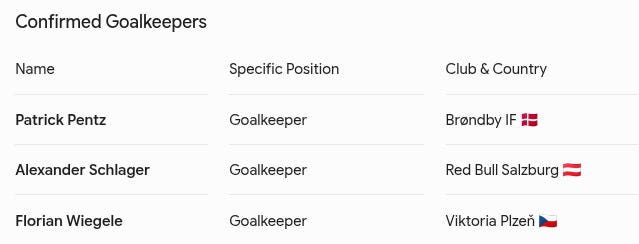
The position with the most uncertainty for the Austrian national is goalkeeper. The competition is between Red Bull Salzburg’s Alexander Schlager and Brøndby IF’s Patrick Pentz with the former starting most of the matches during UEFA world cup qualifying however Pentz has featured as well. Both keepers are experienced and have represented their national teams well when called upon, so Rangnick should feel comfort in knowing that he has two keepers he can trust. Schlager might get the initial start since he is a bit more experienced but Pentz will be ready to step in at a moments notice.
Defense
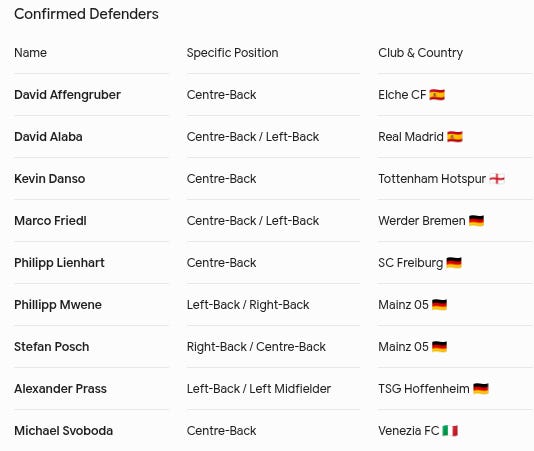
For the most part, Austria’s back four is settled, with star man Laimer lining up at right back and he sets the tone with his energy and pressing at the back. His job is to patrol that right flank and press intensely to win back possession immediately and then ignite the counter-attack. At the left back position, Mainz 05’s Phillipp Mwene uses his pace and stamina to exert the press on his flank and force turnovers quickly. Together, the full backs provide width in defense and attack, pushing high to force opponents to make decisions quickly. At center back, Rangick has a strong set of options to choose from including captain David Alaba of Real Madrid, Tottenham Hotspurs’ Kevin Danso, Werder Bremen’s Marco Friedl and SC Freiburg’s Philipp Lienhart. If fully fit, Alaba is a guaranteed starter as he provides experience, versatility, and leadership at the back. He has a powerful and cultured left foot and is an exceptional ball-playing center back, often carrying the ball forward from the back or using his sublime passing range to begin counters from the back. He will likely be paired with Danso, who is more of a physically aggressive and strong defender. Danso and Alaba have high work rates, loving to defend and engage in strong, aggressive duels. When the initial press, from the attackers, midfield and full backs doesn’t work, the Austrian’s transition into a narrow, highly disciplined 4-4-2, leaving little space in the central corridor.
Midfield
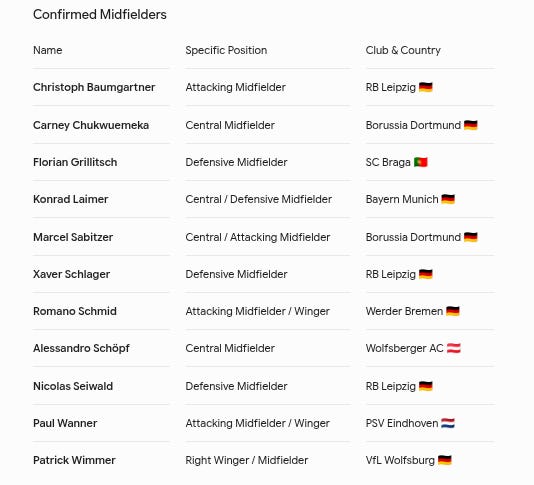
The Austrian midfield emphasizes rapid vertical play, immediate counter-pressing, and utilizing technically gifted, energetic midfielders to dominate the center of the pitch, while the full backs provide width (and extra central over in the case of Laimer). The midfield double pivot consists of two RB Leipzig players: Xaver Schlager and Nicolas Seiwald. Together they protect the back four and give Austria the needed balance to execute their high intensity, high pressing system without leaving themselves exposed. The mandate for the duo is to win the ball back as soon as possible (employing a 5–8 second counter-press immediately after losing possession) and then directly launch quick, vertical attacks.
Attack
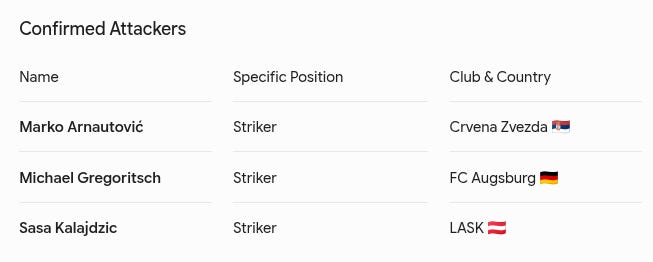
Ragnick’s attacking structure relies on central creativity, midfield intensity and dynamic wide play. Borussia Dortmund’s Marcel Sabitzer is the main playmaking engine of the Austrian attack and serves as both a creator and goal threat. He operates right behind the striker and brings high energy attacking play, whether it be picking out dangerous transitional passes or making late runs into the penalty box to finish off goal chances. Out of possession, Sabitzer is one of the first to start the high press, with his well-conditioned stamina, and sets the tone of the Austrian high-energy system in the attacking third. He is also takes Das Team’s set pieces and penalties, making him a jack-of-all-trades. To the slight left of him will be RB Leipzig’s Christoph Baumgartner and he will play a similar role to Sabitzer, just from a wider position. He brings pace, dribbling, creativity and finishing from the left side and also plays an important role in closing down opposition attacks. On the right side of the attack will line up one of Werder Bremen’s Romano Schid or VfL Wolfsburg’s Patrick Wimmer. When Wimmer starts he brings pace and a directness to the attack while Schmid is more of a technician, with great crossing, dribbling and quick speed skills. The focal point of the Austrian attack is a legendary player, that is still going strong, in 37-year old Marko Arnautović of Red Star Belgrade. Arnautović is the most-capped and top goalscorer (47 goals in 132 appearances) in Austrian national team history. He holds up play really and brings his attackers into flooding the advanced positions, often winning the majority of his aerial duels. While not the clinical striker he used to be, Arnautović still can finish his fair share of chances. Rangnick has depth at his disposal in attack such as Borussia Dortmund’s Carney Chukwuemeka and FC Augsburg’s Michael Gergoritsch.
OUTLOOK
After breaking a 28-world cup drought, Austria come into the 2026 FIFA World Cup as an intriguing team that could make some noise this summer. Their intense, high pressing style of play could at the very least frustrate opponents, but if executed at the highest level, could cause an upset or two. That could be the case against Argentina, as Austria will be their closest competitor in the group. A second place finish seems likely but they can challenge Argentina with their like-for-like styles of play. They are capable of winning a knockout round game but beyond that might be a bit of a stretch to expect much more.
Predicted Group Stage Finish: 2nd
ALGERIA
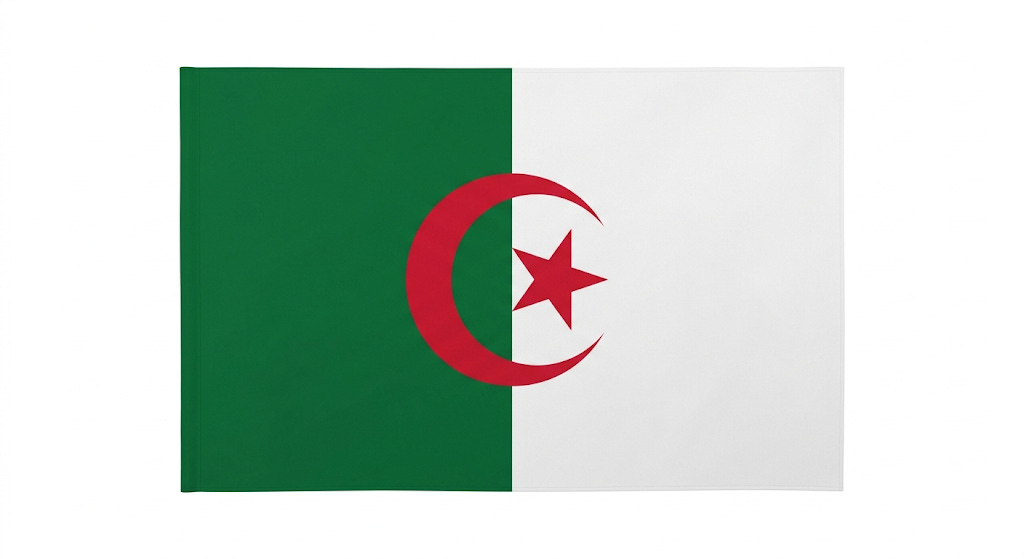
Nicknames: مُحَارِبِي الصَّحْرَاء (The Desert Warriors), الخُضر (The Greens),
الأفناك (The Fennecs)
World Cup Appearances: 5 (1982, 1986, 2010, 2014, 2026)
Best Finish: Round of 16 (2014)
QUALIFICATION
After making back-to-back world cups in 2010 and 2014, Algeria has seen themselves slowly fade off the world’s stage in recent years. The Desert Warriors did manage to win the 2019 African Cup of Nations but the ultimate goal for the national team was to get back to competing for qualification at world cups. That process to do so restarted with CAF world cup qualifying, with the Algerians put into Group G with Uganda, Mozambique, Guinea, Botswana and Somalia. They dominated the group, finishing with 25 points (8 wins, 1 draw and 1 loss) and a +16 goal difference (scored 24 goals and conceded only eight). The Desert Warriors secured qualification with a 3-0 win over Somalia in Oran and booked their ticket to their fifth ever world cup. They will look to replicate the success they had the last time they were in the tournament, when they got out of the group stage.
THE MANAGER
Vladimir Petković
In February 2024, Vladimir Petković was appointed manager of the Algerian national team, with the task of breaking The Desert Warriors world cup drought. Known for his successful spell as manager of the Switzerland national team, from 2014-2021, where he led them to the Round of 16 at the 2018 World Cup and the Euro 2020 quarterfinals, Petković had a short stop at FC Girondins de Bordeaux before returning to international management with Algeria. His preferred formation for The Desert Warriors is a 4-2-3-1/4-2-2-2, with the team playing to their player’s strengths, which is an attack-first. The squad likes to attack vertically and isolate their wingers/full backs to take on defenders in space, with the midfield looking to keep enough sustained possession to allow those opportunities. Out of possession Petković asks his team to sit in a compact mid-block, focusing on using a selective press to disrupt the opponents build up, specifically on backward passes.
THE STAR MAN
Riyad Mahrez
(Right Winger/Right Midfielder)
Now plying his trade in Saudi Arabia for Al-Ahli, Riyad Mahrez is at the tail end of what has been an excellent career. However he is still the star man for Algeria and will play a crucial role in leading his nation this summer as captain. The former Leicester City and Manchester City man is known for his elite dribbling, crossing, ball control and vision. He is a technically gifted winger but operates more as a wide playmaker, often cutting inside to either slide a slick pass into a teammate or take a shot on his own. Mahrez likes to stand up his opponents and shake free of them, with a sudden snap in close ball control, change of directions, trickery, balance, turn of pace, flair and dribbling skills. Gifted with an excellent and cultured left foot, Mahrez is the primary set-piece and corner taker for The Desert Warriors and his curve shots and crosses can be a sublime weapon for the Algerian attack. Probably his most important contribution to the team is his experience, having made 107 appearances for his homeland (he is only one of a potential three players that have had previous world cup experience from 2014) and he is used to high pressure moments, having played in both the intense Premier League and UEFA Champions League with Manchester City, winning multiple trophies.
THE SQUAD
Goalkeeper
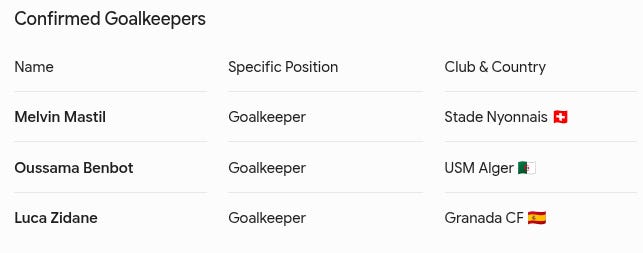
While he hasn’t had the best of seasons for his club side Granada, Petković seems to prefer Luca Zidane as his first-choice keeper. Luca is the son of all-time great French footballer Zinedine Zidane and switched his allegiance from France (which his father represented 108 times) to Algeria, the land of his family’s origins. A solid goalkeeper, Zidane has quick reflexes and reactions, in the mold of a more traditional net-minder. Behind him (or might start) lies Stade Malherbe Caen’s Anthony Madrea, another player who switched allegiances from France, and he brings experience having played 111 times for his club and 21 times for his country.
Defense
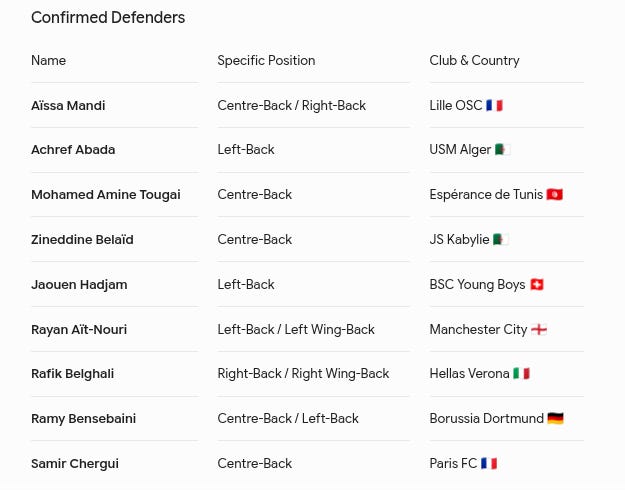
The Algerian back four is based on discipline and aerial strength, feeding off the intense pressing the Algerians deploy further up the pitch. Borussia Dortmund’s Ramy Bensebaini starts at the left center back position while Lille’s Aïssa Mandi (another member of the 2014 World Cup squad) occupies the right center back spot. The duo is one of the most experienced center back tandems at the tournament, with a combined 197 caps between them, and immense European experience. Mandi and Bensebaini closely mark the opponent’s striker, clearing aerial threats, and initiating play from the back with their good technical skills on the ball. Manchester City’s Rayan Aït-Nouri is the defense’s most skilled player and he will line up as an attacking left back, with his great speed, dribbling skills, ball control and crossing. He will race forward to join the attack whenever the Algerians regain possession but also make sure he is in the optimal position to fall back on defense when needed. At right back, Hellas Verona’s Rafik Belghali will start and he will look to also venture forward and provide width, allowing Mahrez to tuck in and run the show centrally in the final third.
Midfield
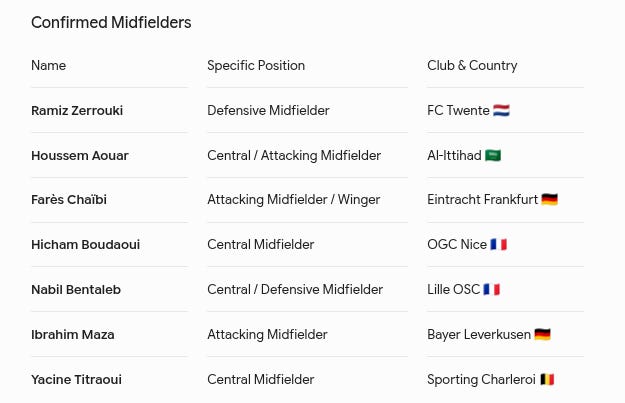
Algeria’s double pivot in midfield plays an important role in ensuring that Petković’s system remains balanced while also creating a springboard for the attack. Lille’s Nabil Bentaleb and Nice’s Hicham Boudaoui work in tandem to dictate tempo, while also applying an intense, coordinated press to win the ball back fast before dropping back into a mid-block. The duo cover a bunch of space and are very good on-the-ball midfielders, making them press resistant. Bentaleb will play as a deep-lying playmaker in the holding midfielder role and his expansive passing range and vision are key to quickly turning defense into attack with accurate long balls and diagonals to the attackers. Boudaoui brings energy, work rate, technical skills and composure in the box-to-box role, providing balance to the midfield, assisting in both breaking up opposition play and initiating transitions. Together the duo manage central spaces, protect the back line against quick counter-attacks, and free up creative players further forward. Petković’s structure offers a balanced, high-energy, and press-resistant midfield, crucial for covering both sides of the pitch and allowing for the full backs to push forward.
Attack
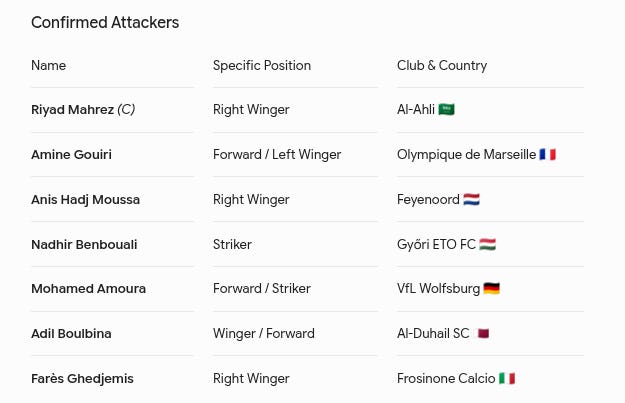
Star man Mahrez is the main orchestrator of the Algerian attack, from the wing spot, but, as mentioned, he likes to roam centrally to change the angle of attack and allow for Belghali to roam forward to provide a wide threat. On the opposite flank, lies another conductor/creative attacking midfielder in Al-Ittihad’s Houssem Aouar. Aouar has excellent dribbling, short passing and ball control and, as a tandem, Aouar and Mahrez work in unison to probe the opposing defenses and find openings to either slip in through balls or open up space for themselves to take on defenders 1v1. Up top, the Algerians operate in a quasi two-striker system that features Marseille’s Amine Gouiri and VfL Wolfsburg’s Mohamed Amoura. Gouri acts as the second striker, making intelligent runs and providing technical quality right behind the main striker. Amoura serves as the primary goal threat for The Desert Warriors and was their top goalscorer during qualifying with 10 goals. He is an explosive player with world class pace, good dribbling, and lethal finishing. The Algerian attack thrives when the forward players run at defenders in space, with Gouri working hard to make smart runs to stretch the defense, while Amoura, Mahrez, Aouar exploit that space to create or finish chances.
OUTLOOK
After missing the last two world cups, The Desert warriors are back on the world stage. They play a high pressing, quick attacking style of game and have a good mix of cultured and physical players to pull off this style. The attack is the main strength of the team and they can pose a threat to teams with their pace, directness and technical skills. However it remains to be seen if their defensive system can hold against stronger teams, like Argentina and Austria. Third place has their name on it, with an outside shot they can challenge for second. If they make it out of the group, the Round of 32 will be the end of journey for the North Africans, as they just lack the experience to make noise in the knockout rounds.
Predicted Group Stage Finish: 3rd
JORDAN
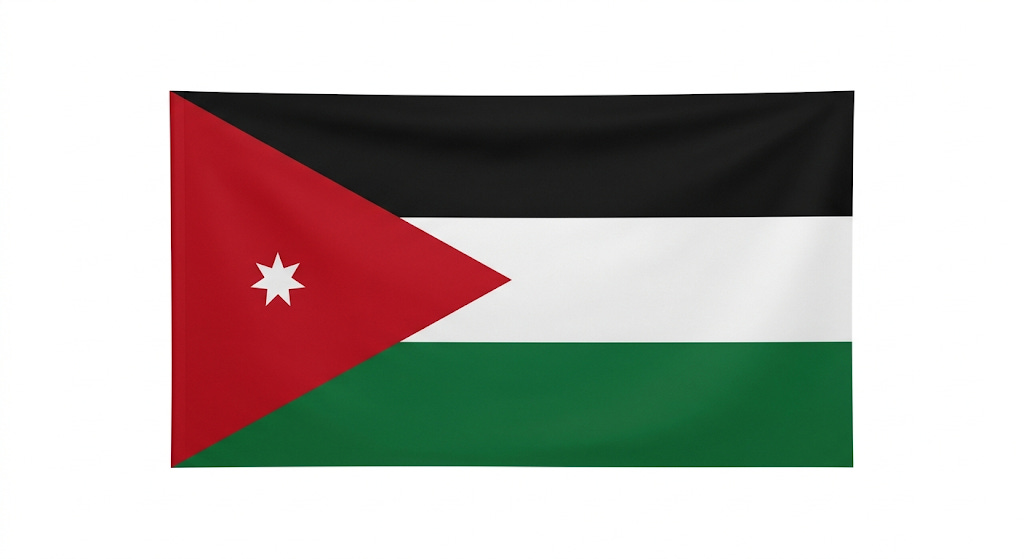
Nickname: النشامى (The Chivalrous Ones)
World Cup Appearances: 1 (2026)
Best Finish: TBD
QUALIFICATION
Back in 2014, Jordan advanced the furthest they have ever done so in world cup qualifying, reaching the AFC–CONMEBOL play-off, only to lose to Uruguay. Since then they haven’t challenged to make any of the past two iterations. However, that all changed when the 2026 FIFA World Cup AFC world cup qualifying cycle began in October 2023. Starting off in the second round, Jordan was placed into Group G with Saudi Arabia, Tajikistan and Pakistan. Jordan were impressive in group play, finishing with four wins, one draw and one loss and a goal difference of +12, which was ultimately the decider in them topping the group and moving into the third round. In the third round, the competition got much tougher in Group B featuring South Korea, Iraq, Oman, Palestine and Kuwait. With South Korea running away with first, Jordan found them selves in a battle to finish second (which also secures direct qualification for the world cup) with Iraq. Jordan managed to qualify for their first ever world cup after defeating Oman 3-0 on June 5, 2025, and with other results in the group falling in their favor.
THE MANAGER
Jamal Sellami
The hiring of Jamal Sellami to manage the national team will go down in history as one of the best decisions the Jordan Football Federation have ever made. The 55-year old Moroccan started his managerial career in his homeland’s domestic league, managing Raja Casablanca and FUS Cabat, before getting the Jordan job. In his time with The Chivalrous Ones, Sellami has turned them into a threatening transition team with his 5-4-1 formation in defense and 3-5-2 in attack. Jordan had the lowest percentage possession numbers of the qualified teams from the Asian team and relied on their back three defenders, supported by wing backs, to handle opposing defenders and begin quick counters. In attack, they are vertically direct and launch counters with urgency. They are designed to win open games where they can use their pace and athleticism to run at stretched defenses. However for these tactics to work, Sellami will have to hope that his defense can hold against the strong attacks of Group J.
THE STAR MAN
Musa Al-Taamari
(Right Winger)
The only player in the entire Jordanian squad to play his club soccer in Europe, for Rennes, Musa Al-Taamari is the star attacker for the team, on the right wing. The first thing you notice with Al-Taamari is he has blistering pace and he loves running at defenders in 1v1 situations, marrying speed with strong technical dribbling, close ball control and reliable finishing. The most explosive athlete on the team, Al-Taamari often cuts inside to be on his preferred left foot to take on defenders with his dribbling, as he is very tidy in the tight half-spaces in the attacking third. Sellami’s system is designed to unleash Al-Taamari in space so he can do what he does best: stress the defense.
THE SQUAD
Goalkeeper
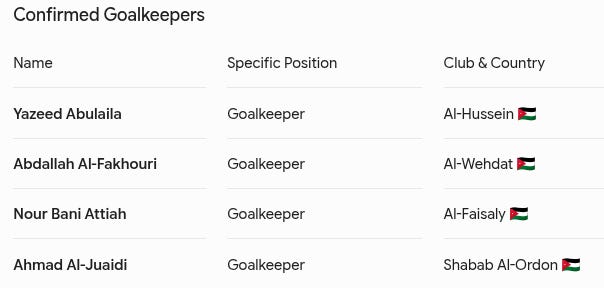
With over 70 caps for his country, Al-Hussein’s Yazeed Abulaila brings experience in net for The Chivalrous Ones. A highly accomplished goalkeeper in the Jordanian Pro League, Abulaila was a central figure in Jordan’s runners-up campaign at the 2023 Asian Cup, where he performed immensely to ensure the team’s defensive solidity throughout the tournament. He will be backed up by Al Wehdat’s Abdallah Al-Fakhouri and Al-Faisaly’s Nour Bani Attiah.
Defense
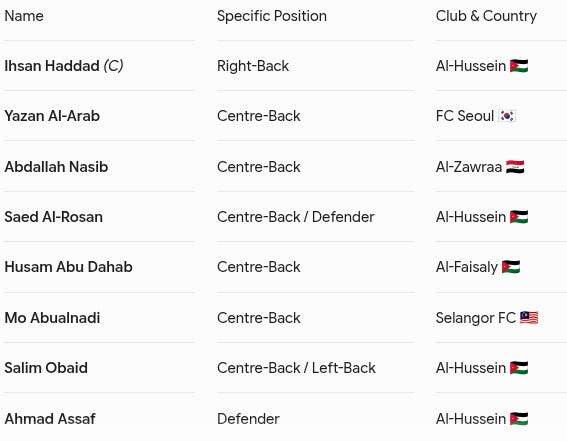
The Jordanians adopt a defense-first mentality when it comes to games and, as a result, operate in a low-block, designed to crowd the midfield, force opponents out wide, and use this approach to serve as a launching pad for quick counters. They are very well organized defensively and encourage opponents to hold possession in non-threatening areas, waiting for the right moment to trigger aggressive tackles and force turnovers. The trio of FC’ Seoul’s Yazan Al-Arab, Al-Zawraa’s Abdallah Nasib and Al-Faisly’s Husam Abu Dahab occupy the three center back spots and form a compact shield to protect the Jordanian net. The three of them are the defensive anchor of the team and guard the penalty box, relying on aerial dominance and positional discipline to neutralize crosses. The center backs outnumber opponent’s strikers and provide the defensive base for the wing back duo of Al-Quwa Al-Jawiya’s Mohannad Abu Taha and Al-Hussein’s Ihsan Haddad to push high in possession while also being a second line of defensive solidity on the flanks. When they join the attack, they make strong energetic runs to provide crosses into the penalty box. In defense, they drop back next to the center backs to form a stretched back-five wall.
Midfield
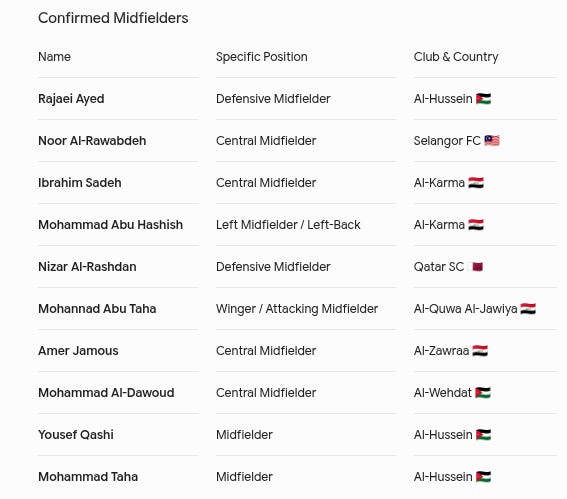
Jordan’s double pivot in midfield works tirelessly to make sure that the back three are not overwhelmed, attempting to break up play before it reaches them. Qatar Sports Club’s Nizar Al-Rasdhdan provides strong tackling as the main defensive midfielder while Al-Zawraa’s Amer Jamous also provides defensive cover but is the most likely of the two to play a bit more advanced to also aid the attack. Once the ball is won back the goal of the duo is to quickly start the attacking transition, launching vertical balls to the attackers.
Attack
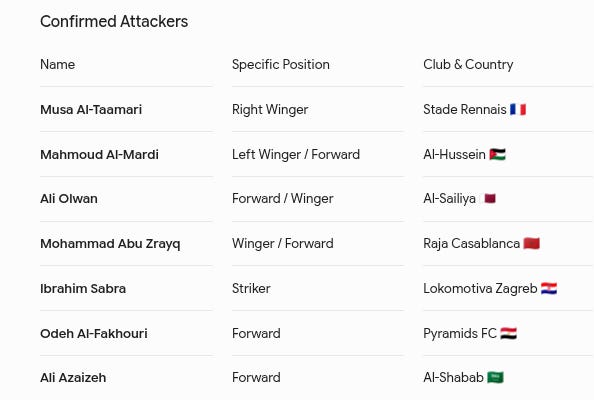
While star man Al-Tamaari is the main scoring threat, his supporting attackers are also very skilled and fast, and they have clear chemistry between them. Al-Tamaari will line up to the left but will operate centrally as well, making smart runs to quickly start the counter. Operating next to him in the attack, on the right and centrally, will be All-Hussein’s Mahmoud Al-Mardi , who makes vertical runs with his power and pace to open up space for combinations in the final third. The target man up top will be Al-Sailiya’s Ali Olwan and his role isn’t so much goalscorer (which he can certainly do) but rather to hold up the ball and bring the other attackers, especially the dangerous Al-Taamari, into the play. Beyond this fast counter-attacking approach, the Jordanians rely on set-pieces and showcased that weapon in Asian world cup qualifying and at the 2025 Arab Cup.
OUTLOOK
Regardless of how the Jordanians perform at the 2026 FIFA World Cup, it should be all celebrations for a nation making their debut on the world’s grandest football stage. That being said, Jordan will want to show they can compete beyond the Asia region but unfortunately the other teams in the group are a huge step up in class. For them to have a chance to cause an upset or two, they will need to hold defensively against the strong attacks of Group J, as they can really only play a counter-attacking style of football. If they can’t, then they will be likely looking at a win less campaign, as they don’t have the tactics or players to be chasing games.
Predicted Group Stage Finish: 4th