
Group E Preview
"Group of Regional Representation"

OVERVIEW
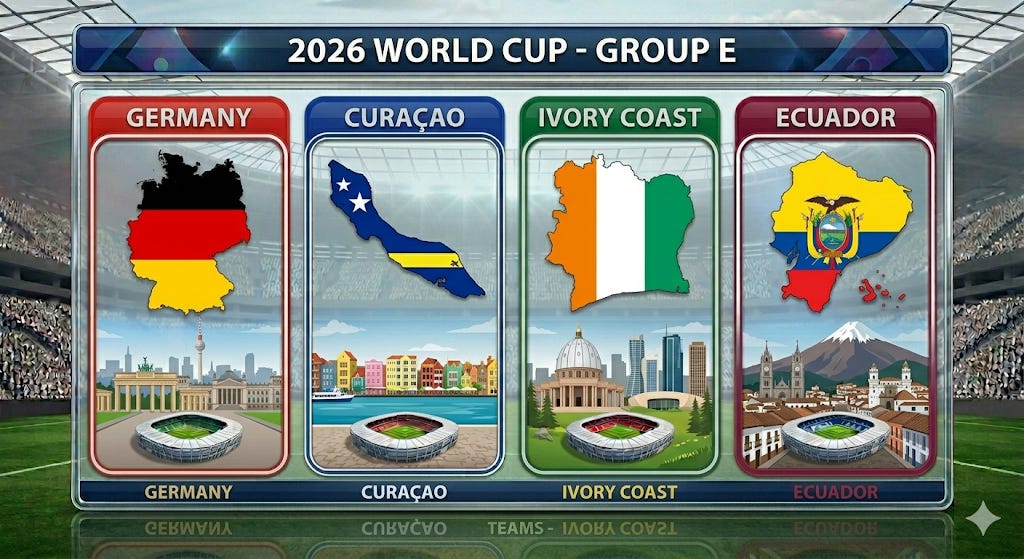
Group E is one of the tougher groups at this summer’s tournament. Four-time world cup champions Germany look to rebound from disappointing showings at the last two world cups and get back on track, as one of the world’s top footballing nations. The “Golden Generation” of Ecuador strives to carry their impressive form from qualifying into the tournament and win their first knockout stage match in their history. After a 12-year absence, the Ivory Coast are back on the world stage with arguably their most tournament ready team. Finally, Curaçao will be making their world cup debut, becoming the smallest nation by both population and geographic area to ever qualify for the tournament.
Skip to: Germany, Ecuador, Côte d'Ivoire (AKA “Ivory Coast”), Curaçao
THE NATIONS
Germany
Nickname(s): Die Mannschaft (The Team), DFB-Team (DFB Team), Die Nationalelf (The National Eleven), DFB-Elf (DFB Eleven)
World Cup Appearances: 21 (1934, 1938, 1954, 1958, 1962, 1966, 1970, 1974, 1978, 1982, 1986, 1990, 1994, 1998, 2002, 2006, 2010, 2014, 2018, 2022, 2026)
Best Finish: Champions (1954, 1974, 1990, 2014) - 3 times as West Germany ,(1954, 1974, 1990), Once as Federal Republic of Germany (2014)
QUALIFICATION
In recent years, Germany has not had any problems qualifying for the world cup. It has been when they get there that they have inexplicably flamed out, not advancing past the group stages at the past two world cups. That is beyond unacceptable for a football powerhouse that has four world cup titles to their name. This time around, Germany will look to play up to the world class standard they are known for and their journey to the 2026 FIFA World Cup started off in UEFA world cup qualifying Group A. Pitted in a group with Slovakia, Northern Ireland and Luxembourg, the Germans, as they always are, were heavy favorites to top the group however they made things a bit trickier than they had to be. A shock 2-0 defeat to Slovakia in Bratislava in the opening match of the group immediately put Die Mannschaft behind the eight ball but they would rally after winning all their remaining games (including enacting a 6-0 revenge result against Slovakia in the return fixture in Leipzig), thus topping the group with 15 points, securing qualification to their 21st world cup.
THE MANAGER
Julian Nagelsmann
Considered one of Germany’s brightest young managers, Julian Nagelsmann was appointed the manager of the German national team in September 2023. Prior to taking the job, Nagelsmann first served as manager of RB Leipzing, leading the team to the semifinals of the 2020 UEFA Champions League, before making the leap to the highly coveted job of manager at Bayern Munich. As German national team manager, Nagelsmann has yet to win any trophies but did lead the team to the quarterfinals of Euro 2024 and the semifinal of the 2025 UEFA Nations League, ultimately losing to Spain and Portugal. Known for a possession-based approach and intense pressing aimed at immediately retaining the ball (Gegenpressing), Nagelsmann lines his team up in a versatile 4-1-3-2/4-2-3-1. In this formation, the Germans will press high to retain the ball and then use their creativity to pass through the lines, doing most of their damage centrally. Key to this formation is Nagelsmann allowing his dynamic duo of “Number 10s” the freedom to roam and create, at will, while the rest of the structure supports them in a variety of different ways. Nagelsmann’s team wants the ball so they can play fast and direct.
THE STAR MAN
Jamal Musiala
(Attacking Midfielder)
In a team full of stars, Bayern Munich’s Jamal Musiala stands out. While he has not been able to feature extensively this season due to a serious injury he suffered during last summer’s FIFA Club World Cup, Musiala has started to look like the world class player that he is, upon his return to fitness in January 2026. When he is fully healthy, Musiala is one of the best attacking midfielders in the world and possesses world class close-control dribbling, almost always beating his opponent in 1v1 situations. In addition, he has amazing vision and passing range, often seeing passes others can’t even envision. Musiala will be one of the main keys to the German attack, as he will be asked to create but also finish chances that he crafts for himself. One word to describe Musiala is “cerebral” and often it feels like he is playing the game on another level than the other 21 players on the pitch.
THE SQUAD
Goalkeeper
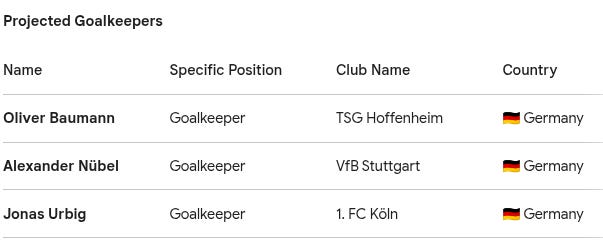
For many years, Girona’s Marc-André ter Stegen (on loan from FC Barcelona) was anointed as the future number one keeper for Die Mannschaft, following the international retirement of legendary keeper Manuel Neuer. Unfortunately that won’t be the case at this world cup, as Ter Stegen will miss the tournament due to a hamstring injury he suffered in February 2026. This has opened the door for Hoffeheim’s Oliver Baumann to be the main man in net for the Germans. Despite only 11 appearances (six of which were in world cup qualifiers) for the national team, Baumann is an experienced keeper, starting over 380 games for his club and, while he is not at the level of Ter Stegen, he is a solid veteran presence in net. He will be backed up by VfB Stuttgart’s Alexander Nübel and Bayern Munich’s Jonas Urbig.
Defense
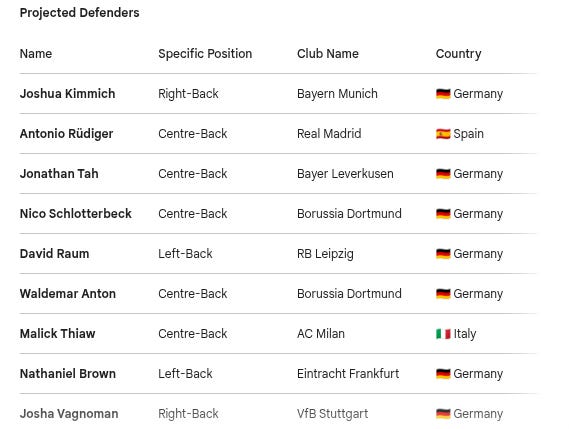
The German’s back line is one of the more stable units at this world cup. Bayern Munich’s Joshua Kimmich commands the right back spot, providing tactical intelligence and control. Kimmich is one of the best right backs in the world and he can also play the inverted fullback role and step into midfield to dictate play from there with his excellent passing range and vision. He is also one of the best crossers in the world and will overlap to support the attack from the right flank. On the opposite side will be RB Leipzig’s David Raum who will push aggressively forward from the left. Occupying the center back positions will most likely be the pairing of Borussia Dortmund’s Nico Schlotterbeck and Bayern Munich’s Jonathan Tah. Real Madrid’s Antonio Rüdiger will also be in contention to start at center back and together the three are calm and composed on the ball while also dominant in the air. The defense is full of experienced players that are disciplined in their roles and maintain compactness when the Germans are on the attack.
Midfield
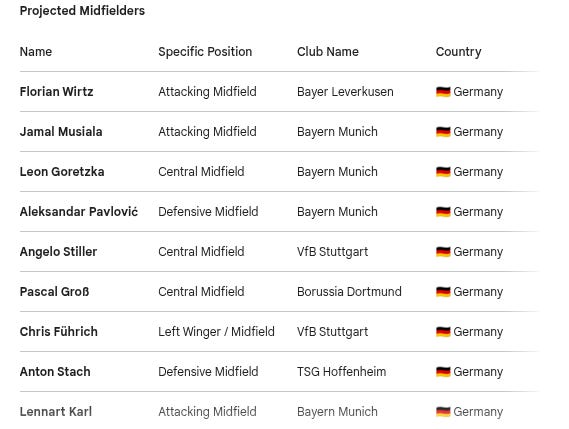
The Germans double pivot in midfield compromises of two Bayern Munich teammates: Aleksandar Pavlović and Leon Goretzka. Together they will absorb any pressure thrown at them and protect the back four from being overwhelmed by the opposing attack. Pavlović serves as the deep-lying playmaker, dictating the tempo and vertical distribution. His partner Goretzka will be asked to be more of the box-to-box midfielder, carrying the ball forward while also bringing physicality in breaking up attacks with the press. Nagelsmann’s double pivot is crucial to allowing the attacking players to take risks and be as creative as they can further up the pitch. The Germans have some quality depth, as well, to supplement the double pivot off the bench in the form of Borussia Dortmund’s Felix Nmecha, Brighton & Hove Albion’s Pascal Groß and Leeds United’s Anton Stach.
Attack
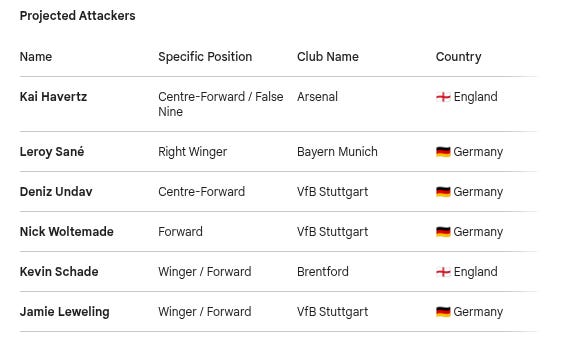
The two “Number 10s” for Germany are what really make this team go and they will be key to unlocking opposing defenses, at the base of the attacking diamond. Star man Musiala, alongside Liverpool’s Florian Wirtz, operate centrally in the tight half-spaces and will interchange often as they probe and prod the opposing defenses with silky dribbling and creative passing. The Musiala-Wirtz partnership will be one of the most creative attacking duos at the world cup and, together, the overloads they can produce, with the fullbacks and wingers supporting them, can overwhelm even the best defenses. That winger that operates next to them will be Galatasaray’s Leroy Sané and he will be asked to provide width and direct attacking from the flanks but also has the freedom to drift inside as well to interchange with Musiala and Wirtz. At the top of the German’s attack, one of Arsenal’s Kai Havertz or Newcastle United’s Nick Woltemade serve as the attacking focal point. Havertz is more likely to get the nod at striker, as he combines physicality with technical excellence to give them a versatile forward that can bag goals as well as create for others. Standing at 6’6”, Woltemade profiles as a target man striker but he possesses some very strong technical skill and vision, often preferring to play with the ball at his feet rather than in the air. Whoever Nagelsmann chooses at striker will be tasked with scoring goals but also will need to be fluid enough to drop a little deeper and help break down opponents.
OUTLOOK
Based on their poor showings in their last two world cups, Germany will enter the 2026 FIFA World Cup as more of “dark horses” rather than top-tier contenders. The team has a unique blend of experience and elite young talent (particularly the Musiala-Wirtz duo) to be a very dangerous team come summer. They are more vertical and explosive than past German teams which makes them an exciting and intriguing watch. They should win the group with only Ecuador really being their closest challenger. If they can put it all together and continue to grow into the tournament, Die Mannschaft have what it takes to make it to the final and win their fifth world cup, which would tie the record for most world cups, currently held by Brazil.
Predicted Group Stage Finish: 1st
ECUADOR
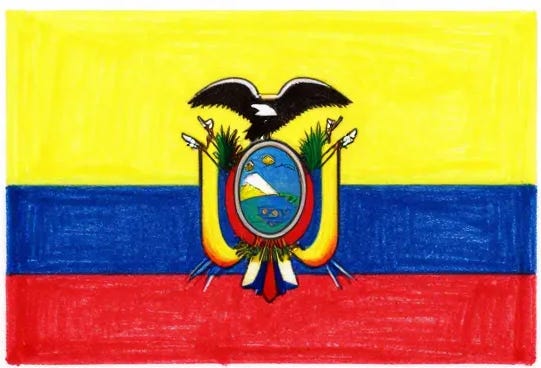
Nickname(s): La Tri (The Tri), La Tricolor (The Tricolours), La Seleccion(The Selection)
World Cup Appearances: 5 (2002, 2006, 2014, 2022, 2026)
Best Finish: Round of 16 (2006)
QUALIFICATION
The “Golden Age” of Ecuadorian football is now. With a team full of players playing in some of the best leagues and teams in the world, the Ecuadorians have become one of the top teams in South America and it showed during CONMEBOL world cup qualifying. Despite receiving a three-point deduction at the start of qualifying as a penalty for fielding an ineligible player in the lead-up to the 2022 FIFA World Cup, La Tri was able to overcome that deficit and climb the table rapidly. Consequently, they secured their world cup qualification with two games to spare in June 2025. The Ecuadorians would finish second in the South American group table with 29 points: the highest finish the country has ever recorded. Throughout their qualifying campaign, the Ecuadorians proved to be a defensive juggernaut, only conceding five times in 18 qualifiers and recording impressive 1-0 wins over Argentina (who finished first) and Colombia.
THE MANAGER
Sebastián Beccacece
Following a disappointing 2024 Copa América, the Ecuadorian Football Federation sacked former manager Félix Sánchez and replaced him with 45-year old Argentine Sebastián Beccacece. This manager change sparked a defensive revolution for the national team, as Beccacece has turned La Tri into one of the best defensive teams in the world, as evidenced by their goals against record in South American world cup qualifying: a region which is full of elite offensive talent. Beccacece has instilled a defensively rigid, high-intensity pressing philosophy to the Ecuadorian national team and utilizes a 4-2-3-1/4-4-2 formation. His team set-ups in a compact low-block defensive structure (often with two banks of four) and when attacking opt for fast, direct vertical transitions rather than keeping possession for long periods of time. The Ecuadorians, under Beccacece, won’t score loads of goals (a third of their qualifiers ended 0-0) but they will be extremely hard to score against and have enough counter attacking talent to punish teams that commit to testing their defensive structure. Patience is key for Beccacece’s men and with their elite defensive spine coupled with a pacey counter attack, they will be a tough out at this summer’s world cup.
THE STAR MAN
Moisés Caicedo
(Defensive Midfielder)
Chelsea’s Moisés Caicedo is one of the best defensive midfielders in the world and is the main engine of Ecuador’s midfield. He has elite defensive awareness and ball-winning capabilities and can dominate the defensive midfield position with both his intelligent positioning and progressive passing skills. Caicedo is particularly adept at reading the game well and intercepting opponent’s passes to turn defense into quick offensive counters for his nation. His calmness on the ball also stands out and he is press resistant, using his excellent close control to navigate tight spaces and maintain possession. White he can also play the box-to-box role, if need be, he will more often than not remain the deepest-lying midfielder in Beccacece’s system and is really the key to Ecuador’s exceptional defensive spine. He is a ball of energy that is crucial to ensuring that Ecuador can keep its defensive shape given the immense amount of ground he will cover and protect in matches.
THE SQUAD
Goalkeeper
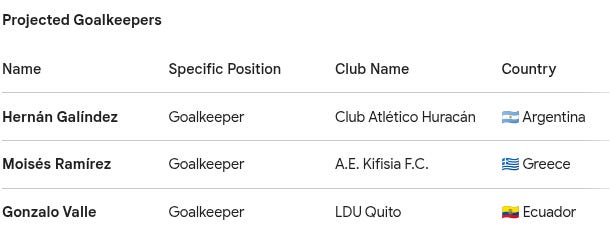
There might be a competition brewing for the first choice keeper position for La Tri. Huracán’s Hernán Galíndez, who started most of Ecuador’s world cup qualifying matches, probably has the inside track to be the man in net come summer. However LDU Quito’s Gonzalo Valle did start key qualifier matches against Brazil and Peru and impressed in those showings. Beccacece will have a decision to make: go with the experience of Galíndez or the promise of Valle (who just made his debut for the national team in June 2025). He will likely go with the former but Valle is a solid backup that has shown he can step in if need be. A.E. Kifisia F.C. ‘s Moisés Ramírez is firmly penciled into the third keeper spot.
Defense
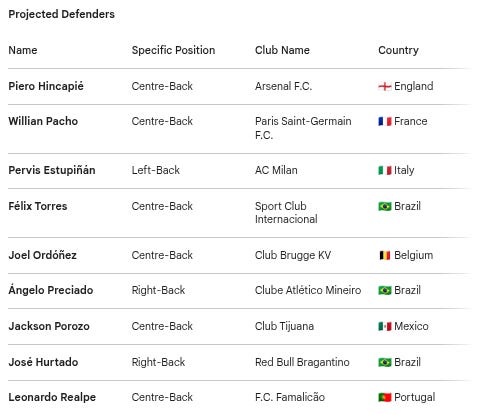
As stated, the defense is the strength of this team and you will be hard pressed to find a more defensively dominant unit at this summer’s tournament. The four man back line is the foundation of Beccacece’s team and they are very difficult to break down. Arsenal’s Piero Hincapié (on loan from Bayer Leverkusen) and Paris Saint-Germain’s Willian Pacho are a dominant center back pairing that is physical, fast, aggressive and excellent on the ball. Despite them both only being 24, they bring an immense amount of experience, as Hincapié was a crucial figure in Bayer Leverkusen’s 2023-2024 unbeaten Bundesliga title winning side, while Pacho has won Ligue 1 (2024-2025), the Coupe de France (2024-2025), Trophée des Champions (2024, 2025), the UEFA Champions League (2024-2025) and the UEFA Super Cup (2025). AC Milan’s Pervis Estupiñán will man the left back position and he brings great crossing ability, pace and a high attacking work rate. He is more of a wing back than a traditional left back, due to his penchant to get forward, but he is also very good defensively, especially with his positioning and physical aggression. Club Brugge’s Joel Ordóñez is another young exciting defender and while he is naturally a center back, he will take up the right back role for his country. More focused on the defensive side of the game than attacking, when his left back partner Estupiñán ventures forward, Ordóñez will slot in more centrally to form a back three with Pacho and Hincapié, ensuring additional defensive solidity when the Ecuadorians press forward. Also comfortable on the ball and a physical specimen that is dominant in 1v1 situations, a strong tournament could see Ordóñez move to one of the top clubs in Europe. The Ecuadorian back line is an elite, modern defensive footballing unit, that brings athleticism, physicality, composure, technique, positioning and high footballing IQ to La Tri.
Midfield
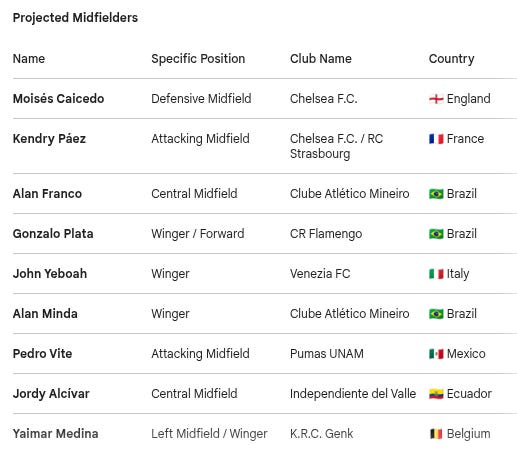
Star man Caicedo bosses the midfield ahead of the back four and he completes the true defensive spine of the Ecuadorian team. His world class abilities to break up play, press intensely and carry the ball forward allow the back four to maintain their shape and structure, even when they are under extended periods of pressure. Caicedo is the anchor of the midfield and ability to create turnovers and start quick transitions makes him the key link between defense and attack. Partnering with Caicedo in the midfield double pivot is Atlético Mineiro’s Alan Franco, who assumes the “Number 8” box-to-box midfield role. Franco also brings energy and work rate to the midfield, combining defensive responsibilities with attacking contributions. Together Caicedo and Franco cover a lot of ground in the middle of the pitch and frustrate opponent’s attacks with their workhorse style of play. In the “Number 10” attacking midfield role is one of Ecuador’s youngest and brightest talents: River Plate’s (on loan from Chelsea) Kendry Páez. At just the age of 18, Páez has established himself a key player for La Tri and will be the main source of creativity for the national team, bringing mature vision and silky dribbling. The youngest player to ever score in a South American world cup qualifier, Páez is versatile and can play the attacking midfielder role but will often roam to the right wing to influence the game from there as well.
Attack
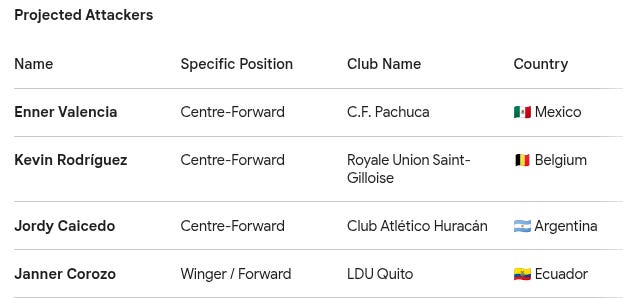
In Beccacece’s counter attacking system, the wingers, along with Páez, need to be able to get up the field quickly into dangerous attacking positions when the Ecuadorians regain possession. As result, La Tri boast a pair of high-intensity, hard working wingers in Sunderland’s Nilson Angulo and Flamengo’s Gonzalo Plata. Angulo will start on the left wing and is an energetic dribbler known for his one-on-one ability as well as his defensive work rate (which is often needed to cover for the overlapping Estupiñán). On the right wing lines up Plata, who also likes to take on defenders but can additionally act as another playmaker from the right side of the attack with his excellent passing ability. Plata will often cut inside or rotate positions with Páez, as he can operate very effectively in the half-spaces. At striker lines up Ecuador’s all-time leading goalscorer (49 goals in 105 appearances for his country) captain Enner Valencia of Pachuca. He brings a ton of experience as the focal point of the attack and while his athleticism might be on the decline, his leadership and finishing instincts are invaluable in a tournament like the world cup. The Ecuadorian attack won’t get an abundance of scoring chances but, when they do, they usually make the most of them with their attacking pace and opportunistic finishing.
OUTLOOK
This Ecuador team has a clear identity, structure and mentality to be a “dark horse” team at this summer’s world cup. Their defense is one of the best at this tournament while their counter attack is effective enough to cause opponents trouble, especially when they overcommit to testing La Tri’s stonewall defensive shape. Ecuador can challenge Germany for top spot and that should be the headline grabbing game of the group. Beyond that, this team has the talent and structure to win their first knockout stage game in their country’s history with a pragmatic style of play that is well-suited for tournament football. This is the best team La Tri have ever fielded at an international tournament and they have a special opportunity to break new ground at the 2026 FIFA World Cup.
Predicted Group Stage Finish: 2nd
CÔTE D’IVOIRE
(A.K.A “Ivory Coast”)
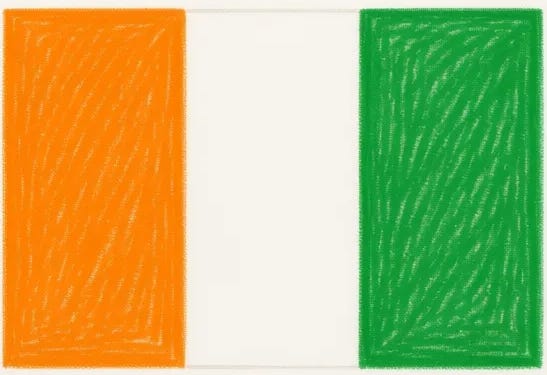
Nickname: Les Éléphants (The Elephants)
World Cup Appearances: 4 (2006, 2010, 2014, 2016)
Best Finish: Group Stage (2006, 2014, 2014)
QUALIFICATION
From the mid-2000s to 2015, the Ivory Coast was one of the most exciting, talented and up-and-coming African footballing nations. Blessed with a “Golden Generation” of top quality players, like Didier Drogba, Yaya Touré, Kolo Touré, Emmanuel Eboué and Salomon Kalou, the Ivory Coast qualified for three straight world cups from 2006-2014 (although they never made it out of the group stages). However since then, the country, for the most part, has failed to replicate that level of talent and missed the 2018 and 2022 world cups. Despite this world cup drought, there was reason for optimism that Les Éléphants could make it back onto the world stage after their 2023 African Cup of Nations triumph, which featured a fresh mix of young talent and solid veterans entering their primes. So when CAF world cup qualifying rolled around, the Ivorians were optimistic they had a team that could break their 12-year world cup drought. Placed in Group F with Gabon, Gambia, Kenya, Burundi and Seychelles, Les Éléphants kicked off their qualifying campaign with a 9-0 win over Seychelles. In the following nine matches, the Ivory Coast went unbeaten in the group (9 wins, 2 draws) and secured top spot and direct qualification for the world cup, with a 3-0 win over Kenya on the final matchday in Abidjan. Their dominance in the group was further made impressive by not allowing a single goal in ten matches, boasting a formidable, watertight defense throughout the campaign.
THE MANAGER
Emerse Faé
A former player for Les Éléphants from 2005-2012, making over 40 appearances for his nation, Emerse Faé took over the national team in the middle of the 2023 African Cup of Nations tournament. Faé went into the 2023 African Cup of Nations tournament as an assistant to then manager Jean-Louis Gasset. However after a poor group stage showing, in which the Ivorians barely advanced to the knockout rounds, Gasset handed in his resignation and Faé assumed the mantle of manager for the rest of the tournament. What followed next was a remarkable turnaround, as Faé would lead the Ivorians to the title and was named Best Coach of the 2023 African Cup of Nations tournament (the first manager in history to take over mid-tournament and then win it). Following that triumph, Faé kept the momentum going and guided the Ivory Coast to this summer’s world cup, notably recording a 10-match undefeated streak in qualifiers and becoming the first Ivorian coach to lead the team to a World Cup. Faé lines his team up in an attacking 4-3-3 formation that is centered around a compact midfield block, dynamic wing play and disciplined defensive solidity. The team can control long stretches of possession but, prefer the direct attack approach, with their speedy, athletic wingers and full backs. Faé has arguably built the most mature, consistent and tournament ready side the Ivory Coast has ever seen in their footballing history.
THE STAR MAN
Amad Diallo
(Winger/Attacking Midfielder)
Over the last few years, Amad Diallo of Manchester United has been a rising star for both club and country. Diallo is a highly technical two-footed player who has great vision and dribbling ability and impacts games in multiple different ways. Often operating on the right wing but also can play centrally, Diallo couples his tricky dribbling skills with impressive acceleration, agility, sprint speed and balance, to be a constant threat against opposing defenders, especially in 1v1s. The 23-year old’s unique close control and ability to operate in tight spaces means he likes to take up dangerous positions in the half-spaces to either create shooting opportunities for himself or for his teammates. For a player his age, his defensive game is quite mature, as he is intelligent in his high pressing and can win the ball back with his anticipation of passing lanes. Diallo will be the primary outlet for the Ivorian attack and, as a decisive attacker, he is capable of moments of brilliance, as evidenced by the crucial goals he has scored for his country in recent competitions.
THE SQUAD
Goalkeeper
There should be no question who will start for Les Éléphants in goal at the world cup. Çaykur Rizespor’s Yahia Fofana has been the main man since Faé took charge and was excellent during the Ivory Coast’s dominant world cup qualification campaign, not conceding a single goal in 10 matches. A composed, commanding presence at 6’4” in net, Fofana is a proactive shot-stopper who also possesses the passing ability to launch accurate long balls up to the dangerous wingers of the Ivorian attack. With Fofana’s ability on the ball, he can act as an extra outfielder during possession to maintain numerical superiority at the back. Fofana is one of the better keepers (if not the best) the Ivory Coast has produced in recent memory and the country will be banking on him bringing that top form he showed in qualifying to the world cup. Behind him the experience significantly drops off, with Panathinaikos’ Alban Lafont and Charleroi’s Mohamed Koné only having four appearances between them for their nation.
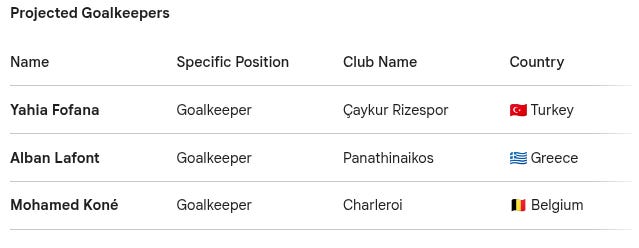
Defense
During world cup qualifying, the Ivory Coast boasted an impressive (and almost unreal) 25-0 goal difference and a big reason for that zero is their rock solid defensive back four. The two center backs, AS Roma’s Evan Ndicka and Atalanta’s Odilon Kossounou, dominate their box and aggressively close down central channels. The pair are strong in the air but are also composed on the ball and can help initiate build-up play from the back. With his full backs, Faé employs an asymmetrical system where left back, Ghislain Konan of Gil Vicente, is given license to push forward and overlap to strengthen the attack while Strasbourg’s Guéla Doué typically takes a more conservative approach on the right and stays “home” in order to prevent counter attacks, should the team lose possession. Due to their athleticism, speed and versatility, the back four is comfortable playing a high defensive line or morphing into a compact mid-block, absorbing pressure before using their physical midfield to win the ball and spring quick transitions. All in all, at the back the Ivorians are a highly disciplined and structured unit.
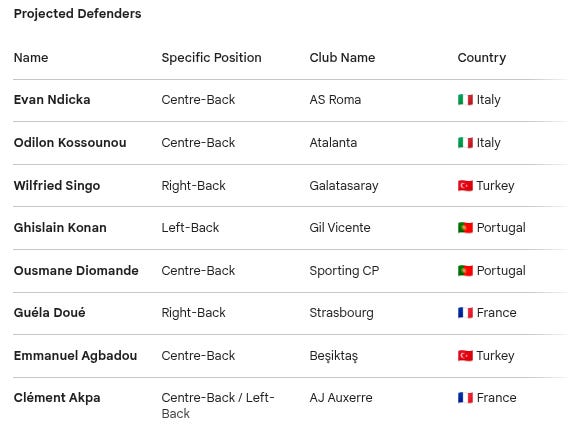
Midfield
The Ivorian midfield is an experienced and powerful unit that is designed to engage in direct physical confrontations and, as a result, are an extension of the strong defensive spine of the team. The anchor of the midfield is the captain, Franck Kessié of Al-Ahli, and he is the tactical heartbeat in midfield, controlling the team’s tempo in and out of possession. Offensively, he is the deep-lying playmaker who will initiate forward progression while, defensively, he uses his powerful athletic abilities to set the tone in midfield duels. The other two members of the midfield three are Nottingham Forest’s Ibrahim Sangaré, who is the pure defensive midfielder in the set-up, and FC Porto’s Seko Fofana, the main goal threat from midfield. Together the trio maintain a narrow structure in order to close down central passing lanes and attempt to funnel the ball wide, where their fast wide players can win the ball back and start counters. The goal is to be physically dominant in the center of the park and win the ball back to ignite rapid vertical transitions out to their dangerous wingers.
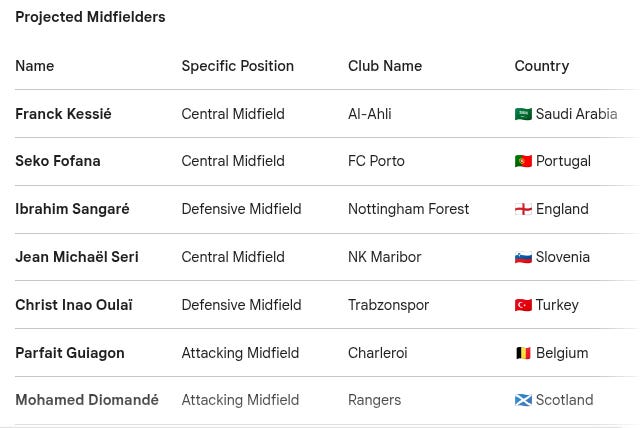
Attack
When it comes to the Ivorian attack, the sum is greater than the individual parts. While star man Diallo is the most dynamic attacker the Ivorians possess, Faé has an array of excellent options that he can call upon. Diallo brings unpredictability, pace and the ability to create something out of nothing on the right wing. On the left wing, Faé has two quality options in AS Monaco’s (on loan from Sunderland) Simon Adingra or RB Leipzig’s Yan Diomande. In particular, 19-year old Diomande is an exciting young winger and has registered 11 goal involvements for his club side in the Bundesliga, bringing great pace, dribbling and ball control to the left wing. He is the Ivorians brightest young talent and could see himself move to a top club with a breakout performance at this summer’s world cup. The Ivorians like to force overloads on the flanks and, as a result, both wingers will tuck in often to allow space for the overlapping full backs (more so on the right than the left). At striker, assuming the physical focal point attacking role, Crystal Palace’s Evann Guessand will likely start. He will be asked to drag defenders out of position to open up room for the pacey wingers. Off the bench, Faé is flush with attacking depth that bring additional speed, physicality, and experience, such as Villareal’s Nicolas Pépé, Hoffenheim’s Bazoumana Touré, Utrecht’s Sébastien Haller and Nice’s Elye Wahi. The hallmark of the Ivorian attack is that they boast a collective goal threat, with 15 different players scoring during world cup qualifying. This makes them a hard team to defend, as opponents can’t focus on stopping one single goal threat.
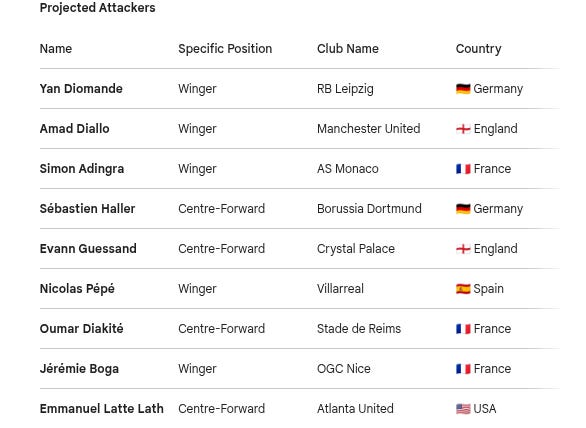
OUTLOOK
The Ivory Coast come into this summer’s tournament as a team with a clear identity around defensive physicality and athletic attacking transition play. The manner in which they qualified from the African region, scoring 25 goals and conceding none, shows they are a balanced team in both attack and defense. However it remains to be seen if that approach will work against the step up in competition, particularly the likes of Germany and Ecuador. In a tough Group E, Les Éléphants will battle for that second spot in the group but firmly seem to be locked into finishing no less than third, which could be enough to see them through to the knockout rounds depending on other group results. While not the most talented, this is probably the most complete team the Ivory Coast has ever fielded at a world cup and making it out of the group stage, for the first time ever in their history, is a huge accomplishment that they can build off of at future world cups.
Predicted Group Stage Finish: 3rd
CURAÇAO
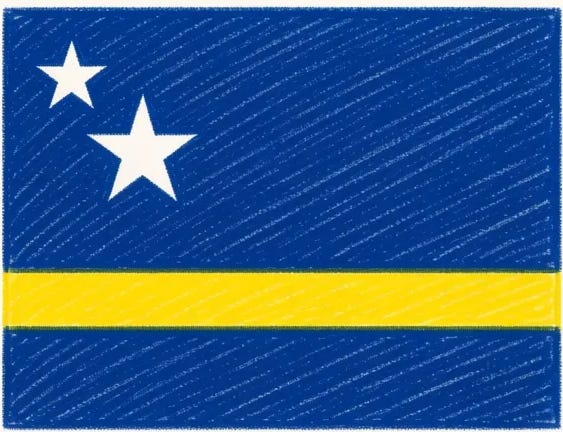
Nickname: The Blue Wave
World Cup Appearances: 1 (2026)
Best Finish: TBD
QUALIFICATION
Making their world cup debut at the 2026 FIFA World Cup, Curaçao are the smallest nation by both population (186,000) and geographic area to ever qualify for the tournament. When CONCACAF world cup qualifying began, Curaçao were definitely a long shot to qualify for the world cup, even with an expanded field of teams and a less packed qualifying region due to Mexico, Canada and USA’s automatic qualification as hosts. What transpired next is a qualifying campaign that will live long in the memory of this small island nation. Entering in the second round of CONCACAF world cup qualifying, Curaçao topped Group C (which consisted of fellow 2026 world cup qualifier Haiti, Saint Lucia, Aruba and Barbados), picking up maximum points and advancing to the third round of qualifying. In the third round, The Blue Wave were placed into Group B with Jamaica, Trinidad and Tobago and Bermuda. They continued their impressive form and went undefeated in the group (3 wins, 3 draws) finishing on the final matchday with a 0-0 draw against Jamaica in Kingston to secure direct qualification to their first ever world cup, capping off one of the most inspiring underdog stories in world cup history.
THE MANAGER
Dick Advocaat
The man that led Curaçao during their historic world cup qualifying campaign was veteran Dutch coach Dick Advocaat. However in February 2026, the 78-year old Advocaat resigned citing personal reasons (caring for his daughter’s health) with another Dutchman, Fred Rutten, taking charge of The Blue Wave. However Rutten did not last long, in part because of disagreements between him and his players, but also because Advocaat’s daughter’s health drastically improved, resulting in him being reappointed as manager in May 2026. With him back at the helm, Advocaat is set to become the oldest manager in World Cup history. Advocaat deploys a 4-3-3/4-4-2 formation with an emphasis on disciplined organization and intelligent pressing. While the The Blue Wave were the top scoring team in CONCACAF qualifying (28 goals) while also keeping six clean sheets in ten matches, against the much stronger opposition they will face in Group E, Advocaat will likely follow a simple formula of sitting deep, absorbing pressure and then exploding forward with pace to hit on the counter. Curaçao‘s collective intensity and spirit will be super important for them to maintain in order for them to have any chance in the group.
THE STAR MAN
Leandro Bacuna
(Center Midfielder)
Iğdır’s Leandro Bacuna captains Curaçao and is one of their most experienced players, having made over 70 appearances for The Blue Wave and previously played for Aston Villa (Premier League), Reading (Championship-UK), Cardiff City (Championship-UK) and FC Groningen (Eredivisie-Netherlands). The Dutch-born Bacuna, now 34-years old, will be the main creative player for his nation in the central midfielder position and brings technical skill, deft passing and powerful long shooting from the center of the pitch. He has a high work-rate and plays the box-to-box role very effectively, bringing physicality to his defensive duties and long passing to his offensive arsenal. A set-piece specialist, he will be in charge of all free kicks for Curaçao and is known as a dangerous dead-ball technique. Bacuna will be the main driving force in the midfield and his experience coupled with his two-way skill set will be vital for The Blue Wave as they venture into uncharted territory on the world’s stage.
THE SQUAD
Goalkeeper
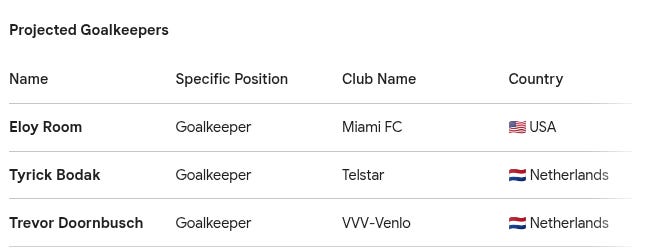
With over 70 caps to his name, Miami FC’s Eloy Room is the unquestioned starter for The Blue Wave this summer. The 37-year old goalkeeper brings a ton of experience as he has played in the Netherlands, US, and Belgium and will be relied on to provide a calming veteran presence in the net. He is an organizer at the back and has been part of title winning sides in multiple leagues (Eredivisie: 2017-18 and MLS cup: 2020) as well as received a multitude of honors throughout his career (Caribbean Cup Golden Glove: 2017, MLS Save of the Year: 2020, and Columbus Crew Defensive Player of the Year: 2021, 2022). His leadership at the back will be invaluable for Curaçao. Behind him are Telstar’s Tyrick Bodak and Trevor VVV-Venio’s Doornbusch.
Defense
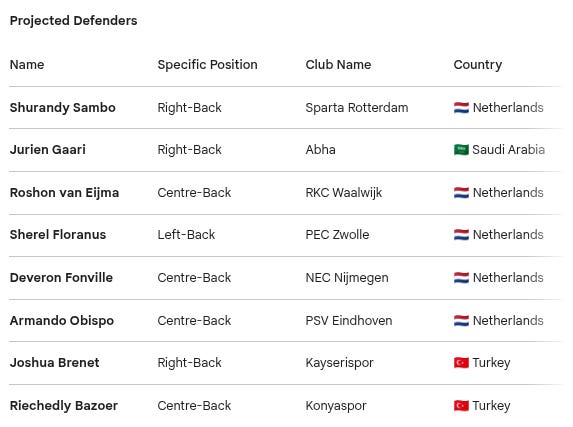
Curaçao’s back four was very impressive in world cup qualifying, conceding only five goals in ten matches, but they will be tested heavily at the world cup. At right back Sparta Rotterdam’s Shurandy Sambo will start while at left back PEC Zwolle’s Sherel Floranus will cover that flank. They likely won’t be too adventurous going forward given the quality of opposition they will be facing in Group E. The center back pairing of Abha’s Juriën Gaari and PSV’s Armando Obispo are physically and tactically disciplined. The emphasis for the back four will be to stay in games and not concede, so they will sit in a compact deep-block, supported by the midfield, and attempt to minimize space for opposing attacks through disciplined organization. With many of the players of Dutch descent and having grown up in the Dutch style of play, they understand structured European defensive systems and can execute them.
Midfield
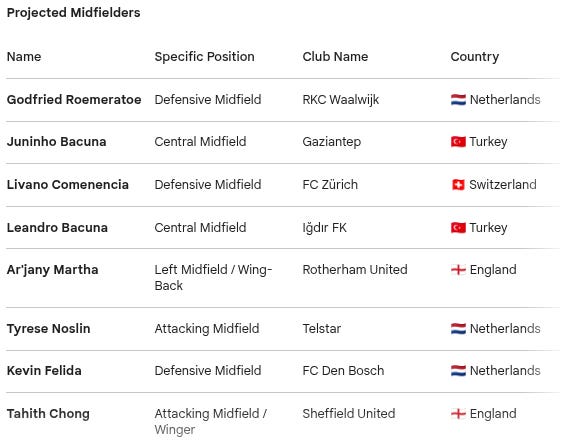
The Blue Wave’s midfield trio will first and foremost be working to support the back line, as they likely wont see much of the ball against the opponents that make up Group E. FC Zürich Livano Comenencia will sit as the deepest lying midfielder and act as a screen for the back four, focusing on breaking up play before it reaches the final third. He will be supported by Volendam’s Juninho Bacuna (the younger brother of Leandro), who led the team in duels in qualifying, while his older brother Leandro will play the box-to-box role, chipping in on the defensive side but also serving as the team’s main creator, orchestrating quick transitions to the front line with key forward passes. Like the back four, the midfield will be asked to absorb a lot of pressure and serve as that first line of defense, narrowing space and closing channels with selective mid-block pressing. When they regain possession, the task is to launch it forward quickly to create fast transitions.
Attack
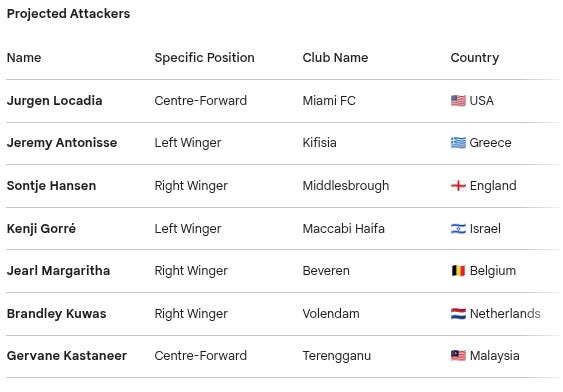
At striker Curaçao can call upon their all-time top goalscorer, FC Eindhoven’s Rangelo Janga, as he has scored 21 goals in 43 appearances for his nation. While Janga hasn’t been preferred in recent games, he is a great option off the bench if Advocaat chooses to utilize him as a super sub. Miami FC’s Jürgen Locadia or Terengganu FC’s Gervane Kastaneer are more in line to be the top two options to start at striker and will need to be physical as the attacking reference point for The Blue Wave. They will be flanked by Maccabi Haifa’s Kenji Gorré on the right wing and Kifisia’s Jeremy Antonisse on the left wing. They will be asked to utilize their speed to catch opponents out of position high up the field and be direct in their attacks. Key to this attacking philosophy will be to try to draw fouls in dangerous areas, as set-pieces might be their best avenue for goals due to their physical archetype of players. The Curaçaoan’s won’t have much of the ball, so it is essential that they convert on the few opportunities that they will generate in the attacking third.
OUTLOOK
Curaçao qualifying for their first world cup is one of the best stories at the summer’s tournament. Unfortunately for them, they were placed in one of the toughest groups at the tournament and the gulf in class between them and the Ivory Coast, Ecuador and Germany is immense. The only way they have a shot in this group is if they can defend effectively for long periods of the game and capitalize on the few chances that they will create through quick transitions. It isn’t really a sustainable formula for success given both the attacks and defenses they will face in Group E. A last place finish seems to be in the cards but The Blue Wave should be proud of making world cup history as the smallest nation ever to qualify for the tournament.
Predicted Group Stage Finish: 4th