
Group I Preview
"Group of Death"

OVERVIEW
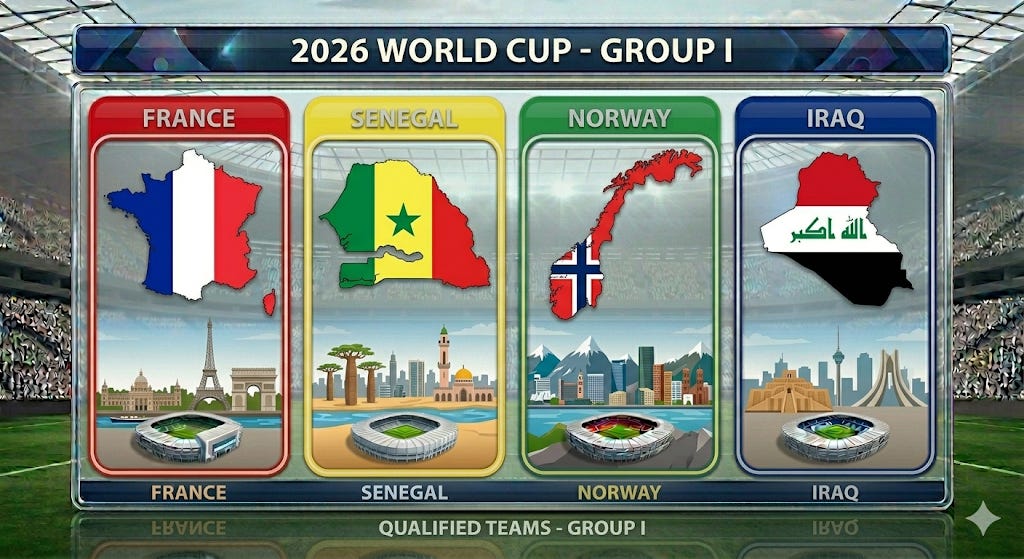
In what will be the “Group of Death” at the 2026 FIFA World Cup, France come into the tournament as heavy favorites to win their third world cup and avenge their final loss to Argentina four years ago. They will be joined by fellow UEFA qualifiers Norway, equipped with a “Golden Generation” of players that look to take the country to new footballing heights. Coming off a controversial African Cup of Nations victory, Senegal set out to prove that they are not just one of Africa’s elite teams but one of the world’s best while Iraq returns to the world cup after a 40 year hiatus.
Skip to: France, Norway, Senegal, Iraq
THE NATIONS
FRANCE
Nickname: Les Bleus (The Blues)
World Cup Appearances: 17 (1930, 1934, 1938, 1954, 1958, 1966, 1978, 1982, 1986, 1998, 2002, 2006, 2010, 2014, 2018, 2022, 2026)
Best Finish: Champions (1998, 2018)
QUALIFICATION
France comes into the 2026 FIFA World Cup ranked as the number one nation in the world by FIFA. While the FIFA rankings can sometimes be controversial, there is no debating that as of right now, France is the best team in the world. Blessed with an embarrassment of world class talent, France’s depth is so deep that their B and C teams could likely even challenge for a world cup. For Les Bleus, world cup qualifying started in UEFA Group D where they were stacked up against Ukraine, Iceland and Azerbaijan. As expected, France dominated the group, going undefeated with their only slip up being a 2-2 draw against Iceland in Reykjavík. They finished top of the group with 16 points and a +12 goal difference (scoring 16 goals and conceding only four), booking their ticket to their 17th world cup. Getting to the world cup was a formality for this team and they have their sights set higher: competing in a third straight world cup final match.
THE MANAGER
Didier Deschamps
As both a former player and current manager of Les Bleus, Didier Deschamps is a legendary figure in French football. He is only the third man to have won the world cup as both a player (1998) and as a manager (2018) and since his appointment in 2012, Deschamps has led France to the quarterfinals of the 2014 FIFA World Cup, the final of Euro 2016, the 2018 FIFA World Cup title and a back-to-back final appearances in the 2022 FIFA World Cup. In his third world cup as manager, Deschamps is equipped with arguably his most talented squad ever and sets them up in a defense-first 4-2-3-1. Deschamps blends a robust defensive structure with lethal, high speed transitions, with France capable of controlling games through their strong double pivot and wreaking havoc off turnovers by utilizing their elite attacking talent. They are extremely hard to break down and operate very efficiently without excessive possession, as at a moment’s notice they can swiftly change the tempo of their methodical attack and break the game open with their world class skill, athleticism, experience, football IQ and speed. In what will be his last world cup as manager of his homeland, Deschamps will want to make the most of his world class squad and become only the second manager in world cup history to win the tournament twice.
THE STAR MAN
Kylian Mbappé
(Striker/Left Winger)
In a squad full of superstars, it can be difficult to pinpoint the one star that rises above all of the others. However for France, that star is Kylian Mbappé, and despite not having the best of starts to his Real Madrid career, he is still Les Bleus’ most talented and important player. When firing on all cylinders, Mbappe might be the best player in the world, as he has a set of world class traits that make him borderline unstoppable, such as: speed, acceleration, agility, reactions, ball control, dribbling, crossing, vision, composure, shooting, jumping, passing and finishing. He is a versatile player who can play on either wing but for France he will line up down the middle as a striker. One of the best finishers in the game, Mbappé loves to run at defenders and his trickery, change of direction and pace make him a terrifying proposition to go against, especially in 1v1 situations (which he is rarely afforded). Mbappé’s high football IQ and vision also make him an extremely dangerous player when it comes to assisting his teammates and he always seems to make the right pass to open the attack for his fellow attackers. He really has it all and if he comes into the tournament in form, he single handily can drive the French attack and rack up the goals and assists for his country.
THE SQUAD
Goalkeepers
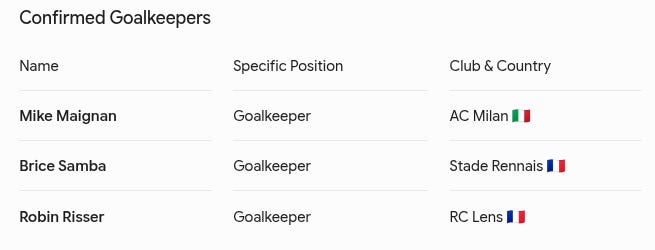
The undisputed first-choice keeper for Les Bleus is AC Milan’s Mike Maignan. Viewed as one of the best keepers in the world, Maignan, nicknamed “Magic Mike”, is known for his imposing stature (6’3”), positioning, physicality, reflexes, shot-stopping, and distribution, as well as his leadership qualities and his ability to effectively organize his defense. He reads the game very well and is astutely proactive coming off his line to deal with any advancing danger. Good with the ball at his feet, Maignan can act as a “sweeper-keeper” if need be and step into the back four to help ignite attacks for the French. On the bench, the French have good keeper depth in PStade Rennais FC’s Brice Samba and RC Lens’ Robin Risser.
Defense
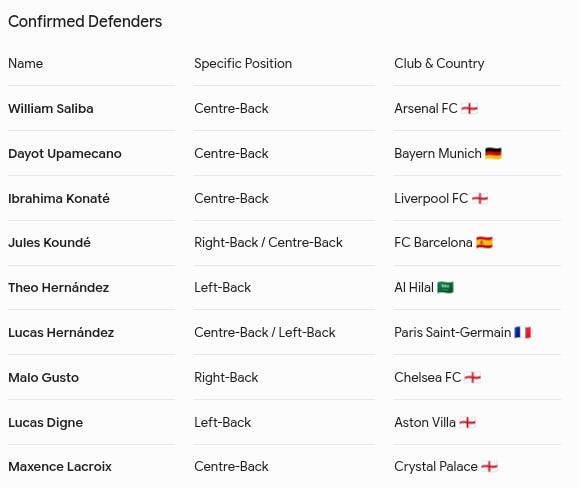
The French starting back line features elite-to-world class players, with high quality depth on the bench. At the center of the back four, Arsenal’s William Saliba headlines the pair, as he is arguably the best center back in the world and turns defending into an art form with his calm and composed playing style. A “Rolls-Royce” of a defender, he excels at proactively reading the game rather than being reactive with last-ditch tackling and, it is very rare to ever be able to get by him, as he has the speed, strength and physicality to handle anything thrown at him. His center partner comes down to two high quality options in Bayern Munich’s Dayot Upamecano and Liverpool’s Ibrahima Konate. Each brings slightly different qualities to the center back position, with the former being a more front-foot, high-intensity athletic defender while the latter is a more physically imposing defender with excellent aerial abilities. Deschamps can’t really go wrong with either but might opt for Upamecano, as his aggressive style pairs well with Saliba’s calmer technician approach. Together the center backs use their elite athleticism to dominate opposing attacks, as there is generally minimal space between the midfield and the back four for attackers to exploit. Barcelona’s Jules Koundé looks set to start at right back and, while he hasn’t had the greatest season for his club, he is a true two-way elite full back, contributing at a high level in both the attacking and defensive sides of the game. He can step into midfield and play the inverted full back role as well and his versatile, technically gifted skills make him a nice chess piece for Deschamps to utilize. On the left side of the back four, Al Hilal’s Theo Hernández probably has the inside track to start with Aston Villa’s Lucas Digne also in contention for the role. Both are attack-minded full backs and in choosing who to start at left back, Deschamps will need to factor in that Hernández brings blistering speed, dribbling and a goal threat while Digne is more defensively reliable and possesses a wicked technical crossing ability. As a whole the unit is difficult to break down, as they sit in a well-organized mid-block and can easily absorb any pressure applied to them with their speed, physicality and athleticism. On the bench, Deschamps call upon very good depth in Crystal Palace’s Maxence Lacroix (Center Back), Chelsea’s Malo Gusto (Right Back) and Paris-Sanit Germain’s Lucas Hernández (Left Back).
Midfield
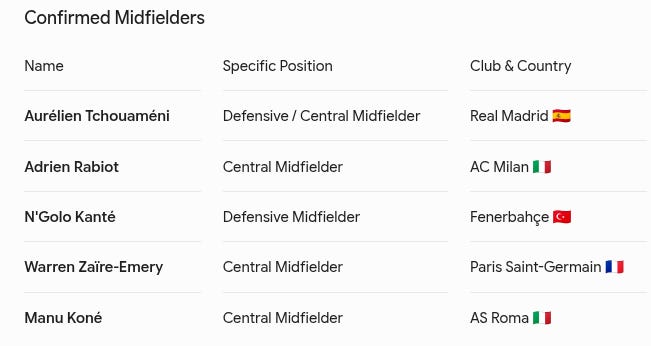
France’s double pivot plays a crucial role in maintaining the overall structure and tactics of Deschamp’s system. One-half of the pivot is set in stone, with Real Madrid’s Aurélien Tchouaméni taking up the the furthest back defensive midfielder role. He acts as the primary defensive anchor and provides cover for the back line while also transitioning play. Tchouaméni is a commanding presence in the middle of the pitch who provides balance to the team and patrols the field, disrupting potential attacks, before they come to fruition, as well as launching the direct elements of the French attack with his cultured passing range. He is always one of the first names on Deschamp’s team sheet but who partners him in the double pivot, as the box-to-box midfielder role, is still up for debate. Deschamps has three high quality-to-elite options to pick from: Paris Saint Germain’s Warren Zaïre-Emery, AC Milan’s Adrian Rabiot and AS Roma’s Manu Koné. Rabiot is the most likely starter, as he gained the trust of Deschamps over the years, but the others are excellent options off the bench (or to start) as each one of them bring dynamism, ball carrying, vision and a relentless work rate. Deschamp’s double pivot is vital in controlling the tempo of the game and allowing the front four freedom to attack at will. In reserve, the French can call upon the savvy veteran N’golo Kante of Fenerbahçe S.K..
Attack
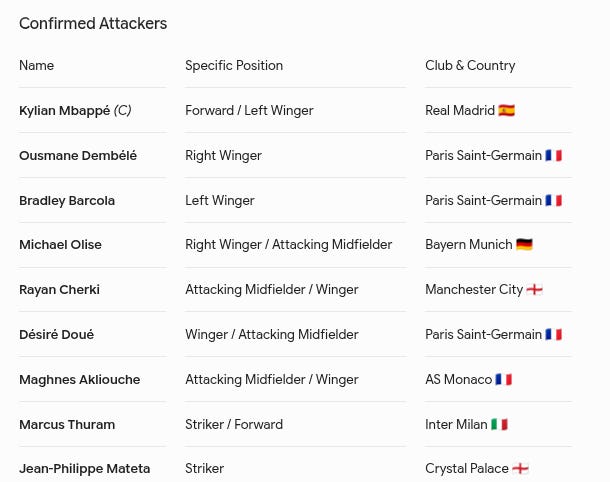
Spearheading the French attack is star man Mbappé, who is given free license to roam in the “Number 9” role. He can drift out to the wings, if need be, but mainly operates centrally and times his runs well to beat offside traps to get behind the opponent’s back line. While the whole attack can chip in with goals, Mbappé will be the main talisman for Les Bleus and his world cup scoring record is outstanding. In just two tournaments, he has reached the final both times, scoring 12 goals, and is also only the second player, after Geoff Hurst, to score a hat-trick in a world cup final. He is supported by an array of world class attackers, starting with 2025 Ballon d’Or winner Ousmane Dembélé of Paris Saint-Germain at the right wing spot. One of only 10 players to have ever won the FIFA World Cup, UEFA Champions League and Ballon d’Or, Dembélé is one of the best wingers in the world and brings directness, speed, technical ability, vision, crossing and finishing from the right flank. On the opposite wing, Paris Saint-Germain’s Désiré Doué will start on the left wing, with the 20-year old considered one of the best young players in the world. Doué is an explosive, “street-style” dribbler with strong close control and a full bag of tricks to his arsenal. In the creative midfielder, “Number 10” role lines up Bayern Munich’s Michael Olise and, currently, he might be the best player in the world. Since his move to Bayern Munich from Crystal Palace, Olise has gone from a great to world class player in a short period of time and his creativity, pace, dribbling, ball control and shooting make him the ultimate weapon. When he finds his attacking rhythm, he can take over a game and slice through an entire defense on his own. The attacking players are given freedom to swap positions and find space, creating a difficult-to-mark, free-flowing system, reinforced by attacking full backs. Elite subs make up the bench in the form of Manchester City’s Rayan Cherki, Crystal Palace’s Jean-Philippe Mateta, Inter Milan’s Marcus Thuram, Paris Saint-Germain’s Bradley Barcola and AS Monaco’s Maghnes Akliouche. The French attack can come at you in multiple waves and containing them for a full 90 minutes is one of the more challenging tasks in world football.
OUTLOOK
The talent the French have at their disposal is unrivaled at this tournament. Collectively they are elite on both defense and offense but also have the game changing individual talent to break open matches and cause chaos for opposing teams. Winning Group I should be a foregone conclusion, as this team expects a deep run in the knockout rounds. Anything less than a third straight appearance in the final would be a failure for Les Bleus, with the belief that when they get there, whoever they face will be no match for their star-studded squad.
Predicted Group Stage Finish: 1st
NORWAY
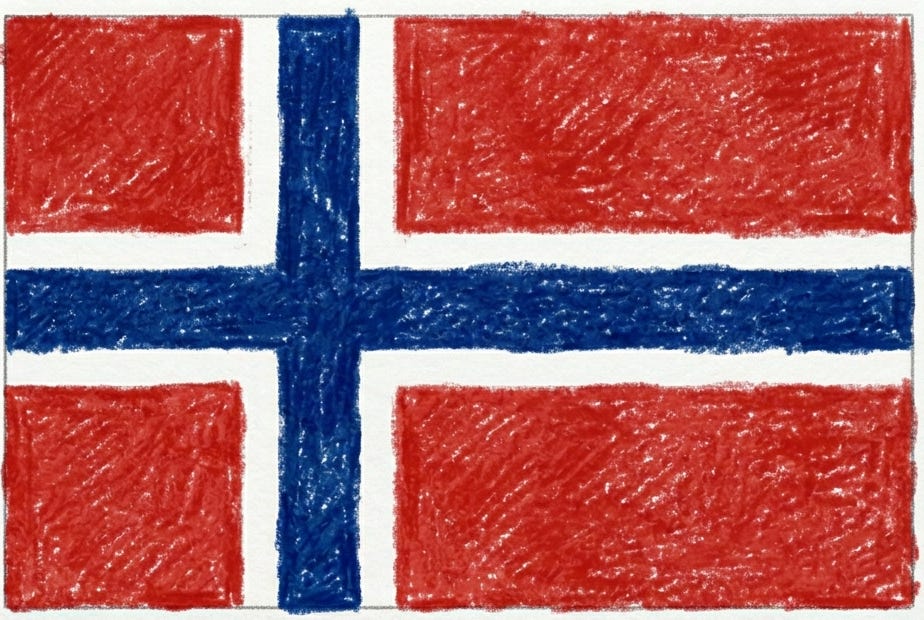
Nickname: Røde, Hvite, Blå (Red, White and Blue), Landslaget (National Team) Drillos
World Cup Appearances: 4 (1938, 1994, 1998, 2026)
Best Finish: Round of 16 (1938, 1998)
QUALIFICATION
Since 2020, Norway has started to establish a “Golden generation” of talent and while they missed the 2022 FIFA World Cup, the squad set out to prove that this group can not only qualify for the biggest tournaments but do some serious damage when they get there. Their quest for their first world cup appearance since 1998 started in UEFA world cup qualifying Group I, as they faced off against Italy, Israel, Estonia and Moldova. The Norwegians had a dominant qualifying campaign, winning all of eight of their matches, including two memorable wins over four-time world cup champions Italy (3-0 win in Oslo and 4-1 win in Milan). Norway topped the group with a perfect 24 points and finished with an eye-popping goal difference of +32 (37 goals scored and five goals conceded), showing that this team will be a scary proposition at the 2026 FIFA World Cup.
THE MANAGER
Ståle Solbakken
Norwegian manager Ståle Solbakken played for his homeland 58 times including at the 1998 FIFA World Cup and Euro 2000. A former midfielder, Solbakken has had a successful managerial career, both in the club and international game, as he was named 2004 Norwegian Manager of the Year and has won eight Superliga titles with FC Copenhagen in Denmark. After the resignation of Lars Lagerbäck in 2020, Solbakken assumed the role of manager and became the first manager to take Norway to the world cup since Egil Olsen in 1998. Known for rigid tactical discipline combined with an attacking philosophy, Solbakken sets his team up in a 4-2-3-1/4-3-3 and under his leadership Norway scored the most goals (37) and registered the most assists (29) during UEFA world cup qualifying. Solbakken’s system focuses on a compact shape, wide progressions, early diagonal passes, and capitalizing on set-pieces. Not as direct as you would expect, Solbakken emphasizes coordinated build-up and combination play to break down defenses.
THE STAR MAN
Erling Haaland
(Striker)
The two main superstars of the Norwegian team are Arsenal’s Martin Ødegaard and Manchester City’s Erling Haaland. While both are world class players, when he is on his game, Haaland is probably the best striker on the planet and therefore gets the nod as the main star man for the Norwegians. Haaland is a physical specimen (6’5”) and looks like he was built in a lab. He is a complete striker and uses his elite sprint speed, acceleration, ball control, strength, aggression, attacking positioning and lethal finishing to be a constant danger in front of the net. The Manchester City man uses his size and strength to hold up play and bring his teammates into the attack but it is his shooting and finishing ability that make him world class. He can score from almost any angle, in a variety of different ways, and make it look easy. Haaland’s strength and determination make it almost impossible to get the ball from him. Opposing teams often have to create specific tactical plans just to deal with his attacking presence and even then those don’t always work in containing him, as he often just needs a half-chance to turn it into a goal. Since joining Manchester City in 2022, Haaland has set the record for most goals scored by a player in a Premier League season (36) and most goals by a Premier League player in all competitions in one season (52) and finished runner-up for the 2023 Ballon d’Or. The only thing that really slows him down is a lack of service, which can make him frustrated and force him to drift wide to get more into the game, leaving the middle of the pitch vacant. However, the Norwegian attacking system is predicated on making sure there is a consistent flow of service to him, as evidenced by his 16 goals in UEFA world cup qualifying, the most scored by any player in the region.
THE SQUAD
Goalkeeper
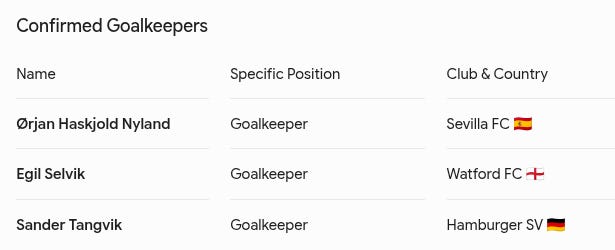
While he hasn’t featured as extensively for his club this season compared to past seasons, Sevilla’s Ørjan Nyland will be the Norwegian number one keeper come June. Nyland is an experienced keeper, having made his debut for the national team in 2013, and is known as a composed, all-round shot-stopper who is comfortable with the ball at both feet. A commanding presence in net, Nyland couples strong reflexes with ball-playing ability and over the years has become a well-rounded modern keeper. Hamburger SV’s Sander Tangvik and Watford’s Egil Selvik serve as his backups, with the former yet to earn a cap for the national team while the latter only has six appearances.
Defense
The Norwegian back line emphasizes a compact, disciplined mid-block rather than constant, high-pressing, allowing them to counter efficiently and protect their penalty area without losing compactness. Solbakken’s back four is built around tall, physically strong center‑backs, led by Brentford’s Kristoffer Ajer and Bologna’s Torbjørn Heggem. The duo uses their height and strength to deal with opposing attackers, especially when it comes to crosses and set-pieces. However both Ajer and Heggem are also good on the ball and calm with their distribution from the back. The center backs take on more zonal marking duties when covering the center while the full backs are more man-oriented on the flanks, usually being the first players to initiate the selective Norwegian press. Offensively, the full backs provide width and overlapping runs as the wingers tend to tuck in more centrally. In the full back positions, Borussia Dortmund’s Julian Ryerson mans the right side while Wolverhampton Wanderers’ David Møller Wolfe plays two-ways on the left. Ryerson is known for his crossing ability and will be asked to provide consistent service when he joins the attack while Wolfe is more defensively sound and might stay back more often, to form a back three when his fellow full back pushes up. Once the back line wins the ball back, the immediate goal is quick transitions, whether they be vertical in nature or quick combination build-up on the ground.
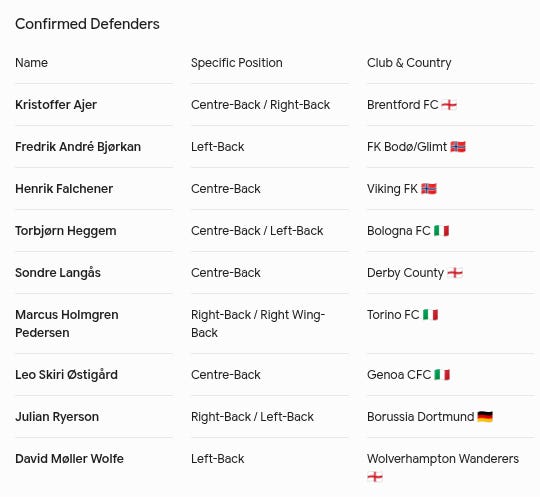
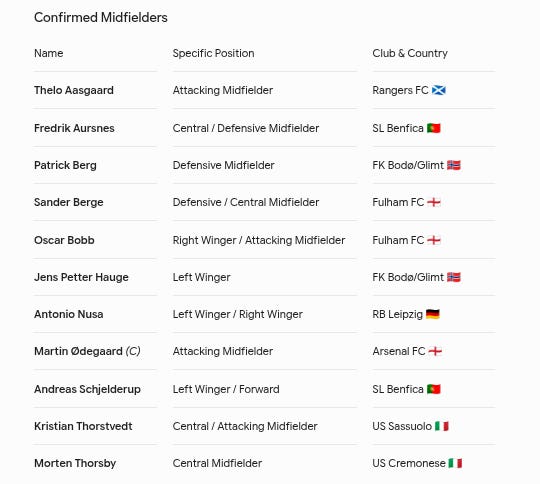
Midfield
Solbakken’s midfield is designed to create quick, direct transitions, high pressing, and support for Haaland, aiming for control and verticality rather than slow possession. The Norwegian’s midfield have a good balance of athleticism and technique, allowing them to win battles and maintain control in high-stakes matches. Out of possession, the Norwegians press is not constant but situational and coordinated. FK Bodø/Glimt’s Patrick Berg serves as the primary defensive midfielder, in charge of central screening to protect the back line and breaking up play. He can progress the ball from deep, if need be, but the box-to-box duties fall on Fulham’s Sander Berge, who is a powerful midfielder with his imposing 6’5” frame. Berge and Berg focus on defending, along with launching direct verticals to the attack, in order to create a solid platform for the main creative force of the team, Arsenal’s Martin Ødegaard, to control the tempo of the game and freely dictate the attack. Ødegaard is one of the best “Number 10s” in the world with an elite deft touch, technique, dribbling ability, vision and range of passing. He often sees and attempts passes that not many would and can unlock a defense in a split second with his next-level playmaking and passing abilities. Ødegaard has a great connection with Haaland and together they are one of the best “one-two punches” in the entire tournament, as he often finds the striker in the spaces between defensive lines. In addition, Ødegaard is one of the better free kick takers in the world and has a dangerous delivery on set-pieces and corners.
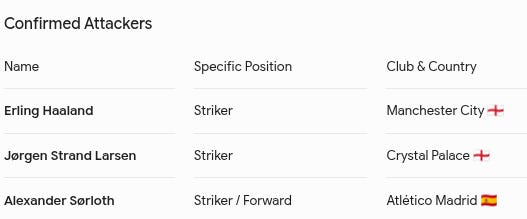
Attack
Supplied by the midfield, the Norwegians focus on rapid, direct, vertical passing to utilize the speed and strength of their attackers before opponents can settle defensively. Star man Haaland’s presence, alone, draws multiple defenders towards him, which opens up space for Ødegaard and the wingers to stretch opposing back lines and provide service to him. While Haaland headlines the attack, he is joined by two high-quality wingers/forwards in RB Leipzig’s Antonio Nusa and Atlético Madrid’s Alexander Sørloth. Nusa is an exciting young winger, on the left , who has explosive pace, refined technical ability and aggressive directness to his play. He loves taking on defenders 1v1 and by doing so, opens up space for Haaland at the far post. Sørloth will start on the right but he serves as more of a secondary striker, right behind Haaland, and provides another reliable goal threat, scoring 26 times for his country. The Norwegian attack aims to put maximum stress on opposing defenses (through their wide players), stretching them to their limits, so Ødegaard can run the show in the half-spaces between the midfield and defensive lines, setting loose the cerebral and clinical Haaland to do what he does best: bag the goals.
OUTLOOK
Norway is a team that no one wants to face at this world cup. They are a sleeping giant that was awoken during UEFA world cup qualifying and have one of the most exciting attacks in the entire tournament. Their front three of Haaland, Nusa and Sørloth can cause havoc in multiple ways and, with Ødegaard pulling the strings, the Norwegians are a well-oiled fluid attacking machine. The midfield and defense are solid, if not spectacular, and they should expect to challenge for second place with Senegal. In the knockout rounds, Norway will be a popular “dark horse” and this team can reach new heights, making it beyond the Round of 16 and potentially farther, if they can fully unleash their attack in North America.
Predicted Group Stage Finish: 2nd
SENEGAL
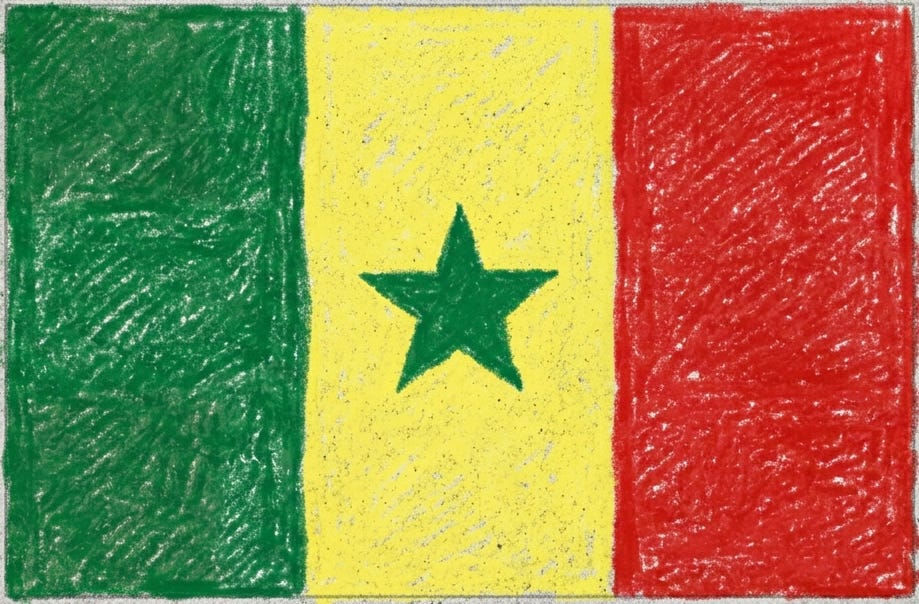
Nickname: Lions de la Téranga (Lions of Teranga)
World Cup Appearances: 4 (2002, 2018, 2022, 2026)
Best Finish: Quarterfinals (2002)
QUALIFICATION
For a team that is one of the powerhouses of African football, it is surprising to realize that their presence at the 2026 FIFA World Cup will only be their fourth appearance ever at the tournament. However, of those previous three times at the world cup, they have made it out of the group stages twice, including an infamous quarterfinal run at the 2022 FIFA World cup in Japan/South Korea. They will be looking to replicate that magic this time around, with their journey to North America kicking off in Group B of CAF world cup qualifying. Grouped with DR Congo, Sudan, Togo, Mauritania and South Sudan, Senegal faced a more challenging qualification process than initially expected. While they finished undefeated in the group, they did register three untimely draws against Togo, DR Congo and Sudan, which made for a close final finish in the group. A crucial 3-2 away win against DR Congo in Kinshasa on September 9, 2025 meant that a 4-0 win against Mauritania on the final match day solidified their position as group winners with 24 points (two ahead of second place DR Congo). Throughout the qualification campaign, The Lions of Teranga showed that they were a complete team, finishing with a +19 goal difference, scoring 22 goals and only conceding three.
THE MANAGER
Pape Thiaw
A member of the legendary 2002 Senegal world cup quarterfinalist team, Pape Thiaw was appointed manager of his homeland in 2024, with the goal to get The Lions of Teranga back to their fourth world cup. He has followed through on that objective and also led Senegal to the 2025 African Cup of Nations final, where they beat Morocco in the final 1-0 in extra time. However the title was eventually awarded to Morocco due to several Senegal players walking off the pitch for roughly 15 minutes after a late penalty was given to Morocco just before the end of regulation time. The decision is being appealed by the Senegalese Football federation but, regardless of the decision, Thiaw has shown that he can navigate a team effectively through tournament football. Thiaw sets his team up in 4-3-3, with high pressing and energy, two staples of his tactics. In addition, his team can control games with a strong and tactically disciplined midfield. He values defensive solidity and using the speed of his wingers to ignite quick transitions. Thiaw oversees what might be the most complete African squad at the tournament, equipped with experience, defensive discipline, physicality and attacking variety.
THE STAR MAN
Sadio Mané
(Left Winger/Right Winger/Attacking Midfielder/Striker)
Despite now being 34-years old and playing his club soccer in Saudi Arabia for Al-Nassr, Sadio Mané is still the star of this Senegal team and brings experience and leadership as the captain of The Lions of Teranga. Capable of playing on either wing or as a striker, the former Liverpool and Bayern Munich man is considered one of the best African players of all time. Known for his finishing, speed, technique, and trickery in possession, as well as his decision-making, tactical awareness, creativity, agility, balance, control, touch on the ball, and dribbling skills, Mané can affect the game in multiple different ways as the primary attacking talisman. For The Lions of Teranga, Mané starts on the left wing but will drift in centrally to serve as the main creative force through the center as well as a goal threat. Beyond his offensive capabilities, Mané works hard on the defensive side of the game and tracks back to provide cover when spaces open for the opposition. His calm and cool demeanor make him a player that does not get phased often which helps him deliver in the biggest moments for both club and country.
THE SQUAD
Goalkeeper
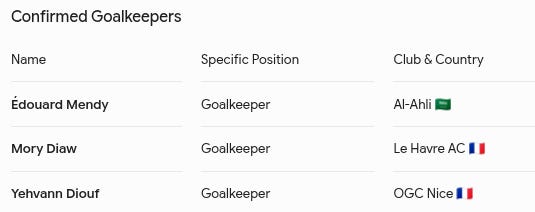
A highly accomplished and experienced keeper, having won the UEFA Goalkeeper of the Year and The Best FIFA Goalkeeper of 2021 awards, as well as the Best Goalkeeper award at the 2021 African Cup of Nations, Al-Ahli’s Édouard Mendy suits up as first-choice net minder for his nation. Mendy is a physically dominant keeper, standing at 6’4”, and authoritatively comes off his line to grab crosses as well as initiate attacks with accurate long range kicking. His extensive experience in major finals and big-match composure will be heavily relied on as he is a commanding presence as the last line of defense for The Lions of Teranga. Behind him on the depth chart will be Nice’s Yehvann Diouf and Le Harve’s Mory Diaw.
Defense
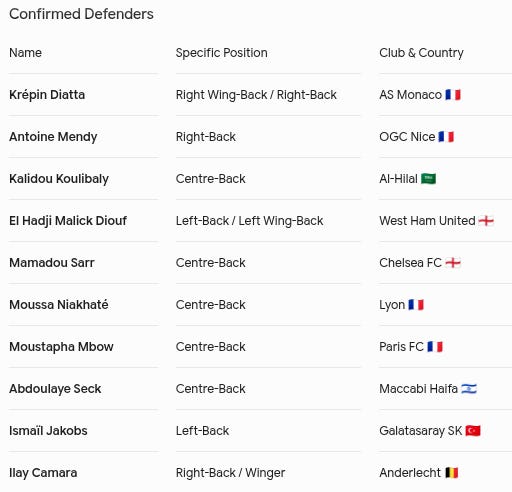
Senegal’s defense sits in a compact, pentagon-shaped mid-block around the midfield to control the middle of the pitch and force opponents into riskier, wider passes. The tightly aligned back four is led by Al-Hilal’s Kalidou Koulibaly and, while he isn’t the dominant defender he used to be in his prime, he is still very experienced as a true leader in the heart of the Senegalese defense. He is proactive in his defending, stepping up to intercept danger and often will look to launch diagonal long balls to spring attacks to the wide wingers. His center back partner is Olympique Lyonnais’s Moussa Niakhaté who brings physicality and aggression. Senegal’s full backs have an aggressive, attacking role in Thiaw’s system, as they will push high up in the pitch to support the attack thus allowing the wingers to operate more centrally. In-possession, the formation morphs into a 2-3-5 (or a 3-3-4 if one of the full backs doesn’t venture forward, which often is the case to ensure defensive solidity), with the full backs providing width, allowing for 2v1 situations to come to fruition in the attacking third. At left back, West Ham United’s El Hadji Diouf starts, while on the right, AS Monaco’s Krépin Diatta gets the nod. As a unit, The Lions of Teranga’s defense rely on a physically robust, organized defensive line, utilizing a mid-block to maintain central compactness and, at times, a high line to restrict space.
Midfield
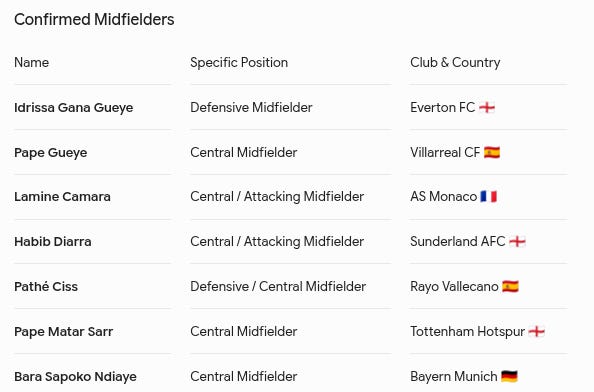
Physicality, strength and stamina are what define the Senegalese midfield three. Initially they look to press high to quickly win the ball back out of possession. If that fails, they retreat into a compact mid-to-low block and, along with the wingers, form a tight cage-like structure in the middle third to prevent passing lanes and force opponents into long, less accurate balls from out wide. In possession, the midfield three look to kick start quick transitions, immediately feeding fast, vertical attackers, in an attempt to utilize open space before their opponents can set up defensively. Everton’s Idrissa Gueye and Villareal’s Pape Gueye provide tactical balance and defensive grit, breaking up plays and advancing the ball forward to their attacks. While both play large roles on the defensive front, Idrissa serves as the main defensive midfield anchor, while Pape assumes the box-to-box role and works to connect with the attack when afforded the opportunities to do so, offering a goal threat from midfield. Sunderland’s Habib Diarra is the most attack-minded of the trio and acts as the “Number 8”, assisting the Gueyes in defense but serving as a creative hub that will look to set loose the attacking trio, with his vision and passing. In African world cup qualifying the midfield were known to control the tempo of the game with long stretches of possession but against the stronger opposition in Group I, like Norway and France, they might cede possession and look to exert their physicality more to disrupt their attacks and quickly counter. Tottenham Hotpurs’ Pape Matar Sarr and AS Monaco’s Lamine Camara represent quality depth of the bench.
Attack
The Lions of Teranga look to attack with speed, width and verticality. As mentioned, Mané leads the Senegalese attack and is given the attacking freedom to stay wide, cut inside or even drop deep into the midfield and pull the strings from there. He is the key playmaker, as well as scorer, in attack and the team will rely on his experience to open up opposing defenses. On the opposite right flank, Everton’s Iliman Ndiaye uses his technical ability and speed to take on opposing full backs and either fashion scoring chances for himself or provide crucial assists to his fellow attackers. He also provides a creative element as a half-winger and when he tucks in, to allow the on-rushing Diatta forward, he serves as an extra playmaker centrally. Bayern Munich’s (on loan from Chelsea) Nickolas Jackson serves as the central striker and has developed into a reliable source of goals for his nation. He uses his pace and intelligent movement to stretch defenses and open up space for Mané, Ndiaye and the other attackers from midfield and the full back positions. Jackson is also a hard worker and is the first line of defense for the team, with his intense counter-pressing. Set-pieces are another important goal scoring avenue for the Senegalese, as they can often dominate with their physicality, strength and aerial abilities on corners and free kicks.
OUTLOOK
Senegal are one of the more complete teams at this tournament, as they have an experienced keeper, a disciplined defensive unit, a powerful midfield and a pacey lethal attack. In any other group, they would be challenging for top spot but in Group I (a.k.a. “The Group of Death”), Senegal will realistically be in competition with Norway for second place. The Norway-Senegal match on June 22 will likely determine who makes it out of the group and who will have to wait and see how other results stack up to determine if third place is enough to advance. If the Lions of Teranga can get out of the group, they are a dangerous team in the knockout rounds, with recent tournament success to fallback on, and should be able to at least win one knockout game, finishing in the Round of 16. A quarterfinals appearance is probably the ceiling for this team.
Predicted Group Stage Finish: 3rd
IRAQ
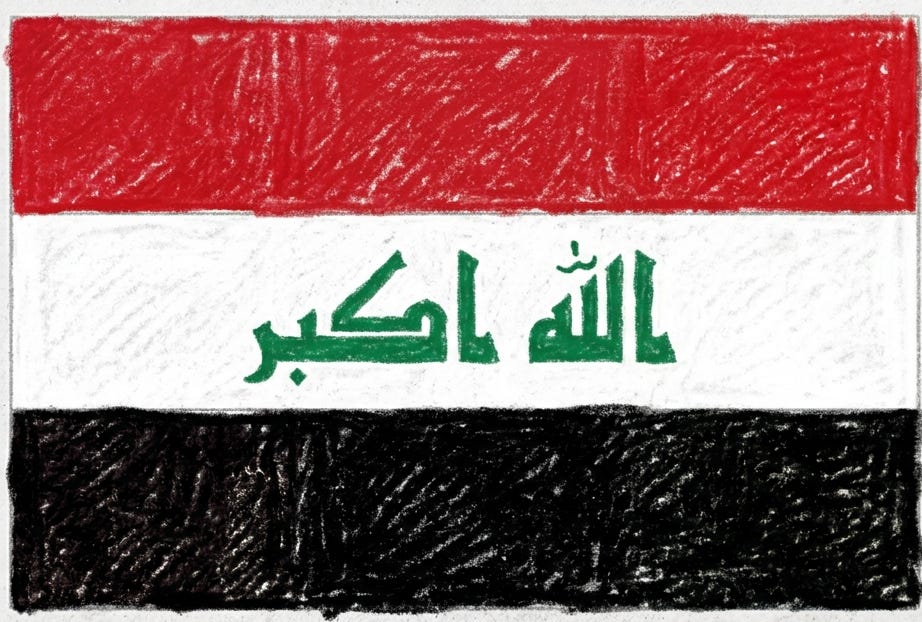
Nickname: Usood al-Rafidayn (Lions of Mesopotamia)
World Cup Appearances: 2 (1986, 2026)
Best Finish: Group Stage (1986)
QUALIFICATION
The last time Iraq made a world cup, the dictator Saddam Hussein was still in power and the country was engulfed in a long eight year war with their eastern neighbors, Iran. Since then a lot has changed for the country and the national team has played a central role in bringing the country together during some tumultuous times in recent history. In one of the greatest underdog stories in world football, the Iraqi national team won the 2007 AFC Asian Cup, despite being in the middle of a brutal civil war and lacking funding, proper training, and stability. Their win in the final against Saudi Arabia united the fractured nation and served as a prime example of football’s power to provide hope and unity. As the country continues to recover from the horrors of war and regional chaos, the current version of the national team set out to carry the tradition of being a symbol of unity and pride for all Iraqis. Their path towards the 2026 FIFA World Cup started in the second round of AFC world cup qualifying. Placed into Group F with Indonesia, Vietnam and the Philippines, Iraq showed impressive form, winning all six of their matches, to top the group with 18 points, thus advancing to the third round. It is here where things got a bit more tricky, as Iraq joined Group B, along with South Korea, Jordan, Oman, Palestine and Kuwait. Despite early gains, Iraq struggled to maintain consistency throughout group play, which ultimately saw them finish in third place, one point out of second, which would have guaranteed them automatic qualification for the world cup. Instead, Iraq was forced to the fourth round and slotted into Group B with Saudi Arabia and Indonesia, with the winner of the group securing world cup qualification and second place headed to a play-off. Despite finishing level on points with Saudi Arabia, an inferior goal difference ushered Iraq into a two-leg play-off against the United Arab Emirates. In the first leg, the teams drew 1-1 in Abu Dhabi but in the second leg, in Basra, Iraq triumphed 2–1, winning the tie 3–2 on aggregate, thanks to a dramatic stoppage-time penalty. However Iraq’s journey wasn’t over yet, as all that victory guaranteed was a one-leg inter-continental play-off against Bolivia, to determine the final team to qualify for the 2026 FIFA World Cup. The match was held at the Estadio BBVA in Mexico, with Iraq defeating the Bolivians 2-1, finally securing their spot at this summer’s world cup tournament. The Iraqi’s path to the 2026 FIFA World Cup is considered one of the longest ever by a national team, spanning 21 matches over a period of 28 months beginning in November 2023. As a result, come this summer, this team will have been one of the most battle tested teams at the tournament.
THE MANAGER
Graham Arnold
Following the shocking 2-1 defeat to Palestine in the second round of AFC world cup qualifying, the Iraqi Football Association sacked former manager Jesús Casas and replaced with Australian manager Graham Arnold. Arnold, who had previously led Australia to the Round of 16 at the last world cup in Qatar, was immediately tasked with helping navigate Iraq through the third, fourth, fifth and inter-continental play-off rounds of qualifying, a feat he successfully achieved. His ability to lead Iraq through so many qualifying rounds is one of the better coaching jobs in international management and he has a squad that is now used to playing in high pressure situations. Preferring a 4-2-3-1 formation, which becomes a 2-3-5 in possession and 4-4-2 out of it, Arnold’s squad sit in a low-block and are happy to absorb pressure, deny space and then hit on the counter. This style of play was on full display during their inter-continental play-off against Bolivia, where the Lions of Mesopotamia only had 32% of the possession yet still won the game 2-1, on just seven shots. However, Arnold’s tactics will be tested to the extreme in the “Group of Death”.
THE STAR MAN
Aymen Hussein
(Striker)
Aymen Hussein’s 53rd minute winner in the inter-continental play-off against Bolivia will go down as one of the most important goals in Iraqi footballing history. With that strike, the Al-Karma SC man sent his nation back to the world cup for the first time in 40 years and, in the process, united a country that has endured immense hardships over the last decade plus. Standing at 6’2”, Hussein is a traditional target man forward, tasked with holding up play, being a physical nuisance against defenders and latching onto crosses in the penalty box. A natural goalscorer, Hussien has scored 33 goals in 93 appearances for his country and is currently Iraq’s 5th all-time top goalscorer. In addition, he has a strong work-rate and presses defenders high up the pitch in order to force turnovers and mistakes. Hussien will be the focal point of the Lions of Mesopotamia’s attack and brings significant experience to the squad.
THE SQUAD
Goalkeeper
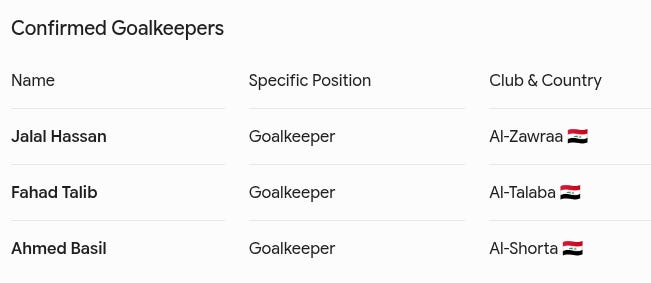
The most experienced player in the Iraqi squad will be their starting goalkeeper, Jalal Hassan of Al-Zawraa SC. Hassan captains the Lions of Mesopotamia and has appeared for his country 100 times, becoming the only Iraqi goalkeeper to claim the starting position in three consecutive AFC Asian Cups (2015, 2019, 2023). However Hassan isn’t guaranteed to start come June with Al-Talaba SC’s Fahad Talib and Al-Shorta SC’s Ahmed Basil are also in contention to be first-choice keeper. Basil started the inter-continental play-off against Bolivia and Arnold might elect to go with him again this summer given his performance in that high pressure match. Whether he starts or not, Hassan’s experience will be crucial to have at a tournament like the world cup.
Defense
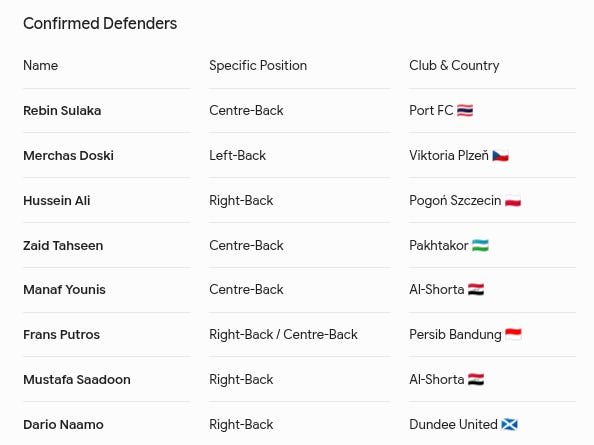
The Iraqis utilize a low-block defensive system and Arnold prioritizes defensive stability above all else. The back four are built to absorb long periods of pressure while denying space behind the defensive line and together they keep a very tight, compact back line to protect the central areas to force attackers out wide. At the center back positions, Pakhtakor FC’s Zaid Tahseen will be paired with Al-Zawraa’s Akam Hashim Rahman and the pair are a youthful, physically strong duo that are good in the air as well capable of playing out from the back. The Iraqi full backs prioritize defensive stability rather than venturing forward, with them supporting the attack mainly by feeding the midfielders. On quick-transitions they may sprint forward to support the efforts but will mainly stay home to keep the defensive shape tight and secure. Two European-based players take up the full back roles, with Pogoń Szczecin’s Hussein Ali playing on the right and FC Viktoria Plzeň’s Merchas Doski taking up his position on the left. Doski is the more likely full back to contribute to the attack with his flat crossing deliveries and has the engine to be a trustworthy two-way player for Arnold.
Midfield
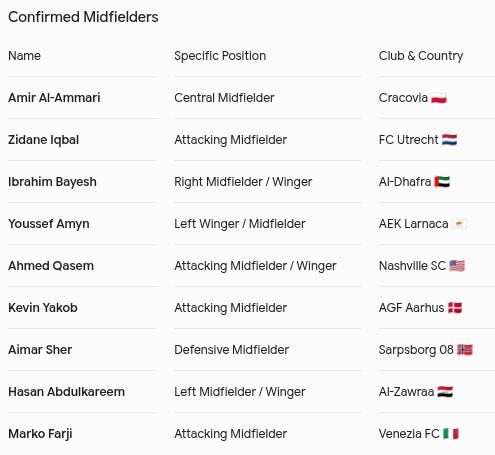
Igniting quick transitions to the attacking forwards is the main goal of the Iraqi midfield. At the base of the midfield lines up KS Cracovia’s Amir Al-Ammari and he serves as the main engine for the Lions of Mesopotamia, controlling the tempo and breaking up play. He likes to dictate play from deep on quick transitions, launching low diagonals up the pitch to spring the attack. He also takes the corners and set-pieces for Iraq. His midfield partner and the creative force for the Iraqis will be FC Utrecht’s Zidane Iqbal. The former Manchester United man is racing to regain fitness ahead of the tournament but, if healthy, Iqbal has the vision and passing range to be a true difference maker for the Lions of Mesopotamia. He will be relied on to make key passes that break open the high-defensive blocks the Iraqis are almost certain to face. The midfield tandem will press when it seems appropriate but mainly look to stay narrow, when out of possession, to make the middle of the pitch difficult to penetrate.
Attack
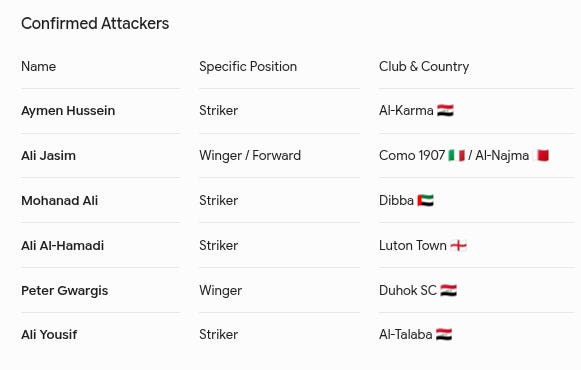
In attack, the Iraqis utilize three wingers/attacking midfielders that aim to spring forward on counter-attacks to exploit space behind opposing defenses. Al-Dhafra’s Ibrahaim Bayesh acts as a more creative winger/attacking midfielder who operates centrally to orchestrate the attack in the final third, ahead of the double pivot. On the right wing, AEK Larnaca FC’s Youssef Amyn is a young rising star for the Lions of Mesopotamia and couples strong dribbling ability with pace to pose a threat in 1v1 situations on the break. The left wing features one of Iraq’s most explosive players, Ali Jasim of Al-Najma’s (on loan from Como). Another high potential young player, Jasim is another source of goals and playmaking for the squad in attack. He usually drifts inside and delivers crosses or takes on defenders with his slick dribbling abilities. At the top of the attack, star man Hussein is the main goal threat and will feed off the supply given to him by his fellow attacking players, in addition to working hard to hold up play and bring his fellow attackers into dangerous forward areas. Luton Town’s Ali Al-Hamadi, is a quality option off the bench, who also could start (as he did in the inter-continental playoff) and he provides extra goalscoring, movement and technical ability at the age of 24.
OUTLOOK
Iraq’s path to the 2026 FIFA World Cup was long and arduous but they showed an immense amount of resilience and determination to navigate so many rounds of world cup qualifying. While they enter Group I as the clear weakest team, they are battle tested, and their defense-first system means they have a chance to hang in games if they can execute it at the highest levels. Anything less and they could be in for a world of hurt, as the attacks that make up Group I are some of the best in the tournament. If they handle the waves of attacks that will be thrown at them and take the few chances they will be afforded, they can steal some crucial points but it seems more likely that the “Group of Death” will be too much for them and a last place finish is the most likely outcome. Regardless, the team has unified a country that has been through so much and that is a win, in and of itself.
Predicted Group Stage Finish: 4th
Nice!